Local Explorer Web Application
Objective
The Local Explorer Web Application enables users to register, log in, select a city, and explore categorized places like parks, temples, and restaurants through a clean, responsive interface. Admins manage city and place details via a dynamic dashboard to keep content accurate and updated.
Abstract
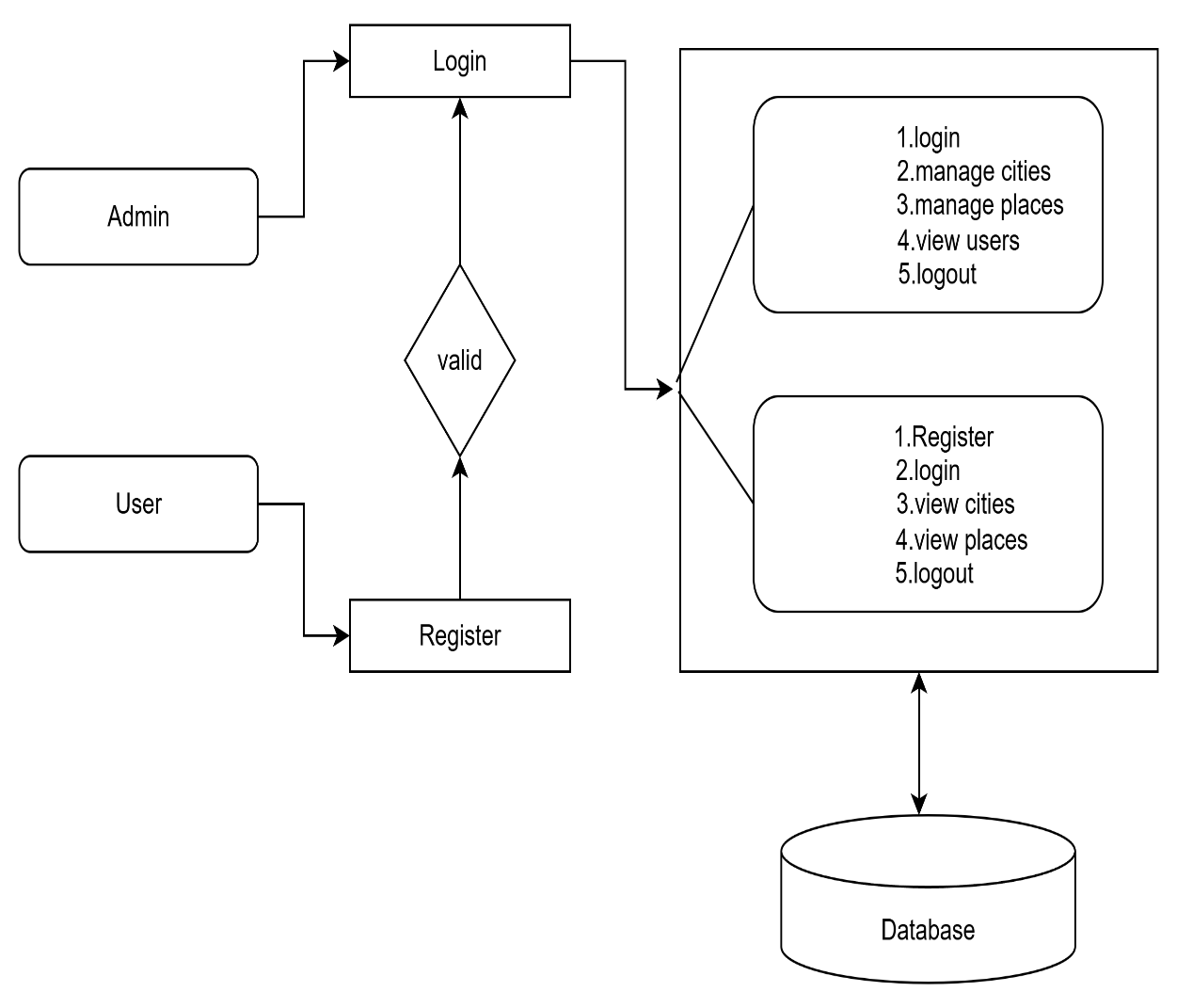
The Local Explorer Web Application is an interactive platform designed to help users explore various cities and discover places of interest such as parks, temples, restaurants, and more. This project is divided into two primary modules: 1. Admin and 2. User. The Admin Module features a centralized dashboard that enables the admin to manage cities and add places categorized by type under each city. Admins can also edit or delete place entries, view the list of registered users, and manage data efficiently. The User Module allows new users to register and existing users to log in securely. Once logged in, users can select a city from the available list and browse through categorized places within the selected city. They can view detailed information about each place, making it easier to plan visits or explore city highlights. The web application uses HTML, CSS, and JavaScript for building a responsive and engaging frontend. The backend is developed using Python Django, which handles user authentication, routing, and data interaction with a lightweight SQLite database.
Keywords: Place Management System, City Place Explorer, City-wise Place Listing
NOTE: Without the concern of our team, please don't submit to the college. This Abstract varies based on student requirements.
Block Diagram
Specifications
HARDWARE REQUIREMENTS:
· Processor - I3/Intel Processor
· RAM - 4GB (min)
· Hard Disk - 160GB
SOFTWARE SYSTEM CONFIGURATION:
· Operating System : Windows 7/8/10
· Front-end : HTML, CSS, JavaScript
· Backend : Django
· IDE/Workbench : VS Code
· Database : SQLLITE


Related Projects
 Paper Publishing

Request Call Back
Would you like to receive a free callback now?
Choose the best time for callback:
Leave your message and we will contact you as soon as possible

6-2-85/B, Old Maternity Hospital Road, Thyagaraja Nagar, Tirupati, Andhra Pradesh – 517501
+91 9030333433
+91 9393939065
0877-2261612

Disclaimer - Takeoff Edu Group Projects are not associated or affiliated with IEEE in any way. The IEEE Projects mentioned here are mentioned in the context of student projects, whose ideas are derived from IEEE publications, not projects of or by IEEE.

