Leaf-Guard A Deep Learning Framework for Early Detection of Plant Pathogens
Objective
The primary goal of this research is to develop a deep learning-based system for detecting plant diseases. This involves training and evaluating three deep learning models CNN, ResNet, and MobileNet on a plant pathogen image dataset to classify plant health conditions. The performance of these models will be compared based on accuracy, precision, recall, and computational efficiency. The research aims to create an easy-to-use system where users can upload plant images and receive accurate health predictions. This tool will help with early disease detection, enabling farmers to make timely interventions, improve crop yield, and reduce losses due to plant diseases. Additionally, the research aims to contribute to agricultural technology by showcasing the effectiveness of deep learning models in automating plant disease diagnosis.
Abstract
This study aims to develop a machine learning model for plant disease detection using deep learning techniques. We utilize a dataset available on Kaggle, which contains images of plant pathogens, to train and evaluate our models. The dataset is structured to help classify plant health based on the presence of various diseases, including bacteria, fungus, and virus, among others.
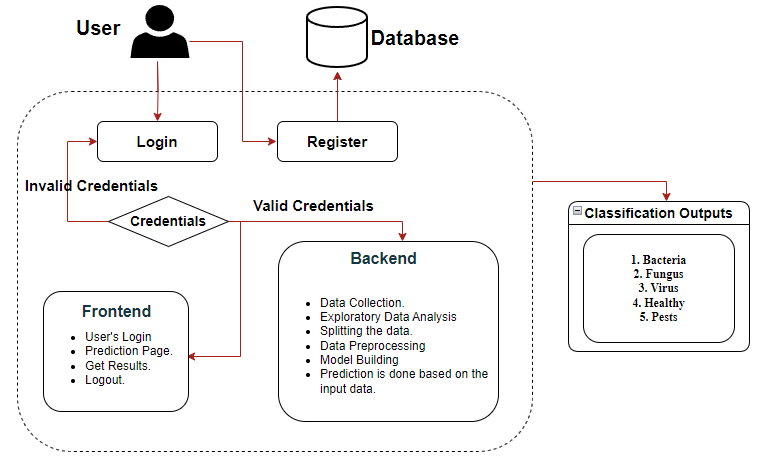
To tackle this classification problem, three deep learning algorithms will be employed: Convolutional Neural Networks (CNN), ResNet, and MobileNet. These models will be trained on the provided plant pathogen image data to accurately predict the condition of the plant. The expected output of the system is a classification label indicating whether the plant is infected with bacteria, fungus, pests, or virus, or if it is healthy.
The proposed solution will allow users to upload images of plants, and the trained model will predict the plant's health status, providing a valuable tool for early detection and intervention in agricultural practices.
Keywords: Plant Disease Detection, Deep Learning, Convolutional Neural Networks (CNN), ResNet, MobileNet, Plant Pathogens, Image Classification, Bacteria Detection, Fungus Detection, Virus Detection, Pests Detection, Healthy Plants, Machine Learning, Agricultural Technology, Early Disease Detection, Image Recognition.
NOTE: Without the concern of our team, please don't submit to the college. This Abstract varies based on student requirements.
Block Diagram
Specifications
H/W CONFIGURATION:
Processor - I5/Intel Processor
Hard Disk - 160GB
Key Board - Standard Windows Keyboard
Mouse - Two or Three Button Mouse
Monitor - SVGA
RAM - 8GB
S/W CONFIGURATION:
• Operating System : Windows 7/8/10
• Server side Script : HTML, CSS, Bootstrap & JS
• Programming Language : Python
• Libraries : Django, Pandas, numpy, Scikit-learn
• IDE/Workbench : Visual Studio code
• Technology : Python 3.6+

Demo Video


Request for Video
Related Projects
 Paper Publishing
Request Call Back
Would you like to receive a free callback now?
Choose the best time for callback:
Leave your message and we will contact you as soon as possible

6-2-85/B, Old Maternity Hospital Road, Thyagaraja Nagar, Tirupati, Andhra Pradesh – 517501
+91 9030333433
+91 9393939065
0877-2261612

Disclaimer - Takeoff Edu Group Projects are not associated or affiliated with IEEE in any way. The IEEE Projects mentioned here are mentioned in the context of student projects, whose ideas are derived from IEEE publications, not projects of or by IEEE.

