LaborEase An Artificial Intelligence-Based Wearable Electrohysterography Device for Preterm Pregnancy Detection
Objective
"LaborEase" is an AI-powered wearable device that utilizes electrohysterography (EHG) signals to detect and predict preterm labor in pregnant women. The device continuously monitors uterine electrical activity through non-invasive sensors and transmits data to an AI system for real-time analysis. Using advanced machine learning algorithms, the system identifies patterns indicative of early uterine contractions and distinguishes them from normal pregnancy activity. By providing early warnings, LaborEase enables timely medical intervention, reducing the risks associated with preterm birth. This project combines wearable technology, biomedical signal processing, and AI to support maternal health through proactive, personalized pregnancy monitoring.
Abstract
Preterm birth remains a leading cause of neonatal mortality and long-term health issues globally. Accurate early prediction can significantly improve maternal care and reduce risks to infants. This research presents a machine learning-based framework for the early detection of preterm birth using Electrohysterogram (EHG) signals. We developed a custom device to capture uterine electrical activity and combined the recorded signals with an open dataset (TPEHGDB) to enhance data volume and diversity.
From 1000-second EHG recordings, we extracted key features such as Count Contraction, Length of Contraction, Standard Deviation, Entropy, and Contraction Time. These features were chosen for their relevance in representing uterine dynamics. The target classification is binary: Preterm (1) or Term (0).
We implemented and evaluated multiple supervised machine learning models, including Random Forest, Decision Tree, Logistic Regression, K-Nearest Neighbors, Multilayer Perceptron (MLP), and Support Vector Machine (SVM). To address class imbalance, Synthetic Minority Over-sampling Technique combined with Edited Nearest Neighbors (SMOTE-ENN) was applied. Performance was validated using 10-Fold Cross-Validation with metrics like Accuracy, Precision, Recall, F1-score, ROC-AUC, Specificity, Cohen’s Kappa, and Matthews Correlation Coefficient.
Results showed that Random Forest and Descision tree models delivered superior predictive accuracy and robustness, demonstrating the effectiveness of using engineered signal features in preterm birth prediction. This study underscores the potential of integrating biomedical signal processing and machine learning to support timely clinical decisions in maternal health care.
Keywords: Electrohysterogram, Preterm Birth, Machine Learning, Random Forest, Descision tree , Feature Extraction, SMOTE-ENN, EHG Signal Analysis, Binary Classification, Maternal Health
NOTE: Without the concern of our team, please don't submit to the college. This Abstract varies based on student requirements.
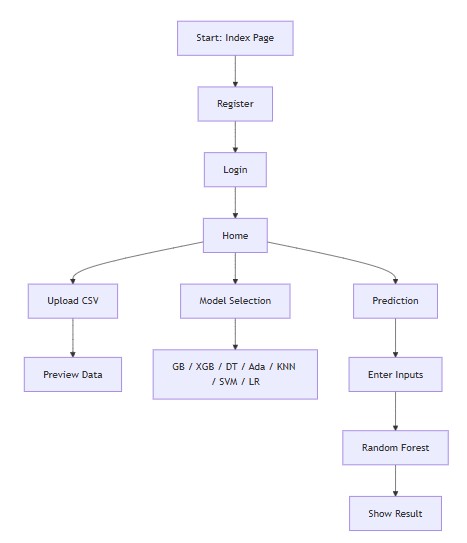
Block Diagram
Specifications
SOFTWARE REQUIREMENS
Operating System : Windows 7/8/10
Server side Script : HTML, CSS, Bootstrap & JS
Programming Language : Python
Libraries : Flask, Pandas, Torch, Keras, Sklearn, Numpy , Seaborn
IDE/Workbench : VSCode
Server Deployment : Xampp Server
Database : MySQL
HARDWARE REQUIREMENTS
Processor - I3/Intel Processor
RAM - 8GB (min)
Hard Disk - 128 GB
Key Board - Standard Windows Keyboard
Mouse - Two or Three Button Mouse
Monitor - Any


Related Projects
 Paper Publishing

Request Call Back
Would you like to receive a free callback now?
Choose the best time for callback:
Leave your message and we will contact you as soon as possible

6-2-85/B, Old Maternity Hospital Road, Thyagaraja Nagar, Tirupati, Andhra Pradesh – 517501
+91 9030333433
+91 9393939065
0877-2261612

Disclaimer - Takeoff Edu Group Projects are not associated or affiliated with IEEE in any way. The IEEE Projects mentioned here are mentioned in the context of student projects, whose ideas are derived from IEEE publications, not projects of or by IEEE.

