Investigation of Deep Learning Techniques Used in Medicinal Plants Identification
Objective
The primary objective of this project is to develop an efficient deep learning-based system capable of accurately identifying and classifying medicinal plants into their respective categories. By integrating advanced CNN and hybrid architectures—specifically VGG16_ResNet50, VGG16_MobileNetV2, VGG16_LSTM, and VGG16_EfficientNetB0—the project aims to enhance the precision and scalability of plant species classification. The system is designed to analyze plant images, extract distinctive features, and classify them among 16 predefined medicinal species such as Arive-Dantu, Basale, Betel, Tulsi, Neem, and others. This automated classification system assists researchers, botanists, and healthcare professionals in the accurate recognition of medicinal plants, thereby contributing to the preservation of biodiversity and promoting the use of herbal medicine.
Abstract
The identification and classification of medicinal plants play a significant role in the field of healthcare and traditional medicine. This study investigates the use of deep learning techniques for the identification and classification of medicinal plants, utilizing various pre-trained models to achieve high accuracy in classifying plant species. The implemented algorithms include VGG16_ResNet50, VGG16_MobileNetV2, VGG16_LSTM, and VGG16_EfficientNetB0, each designed to leverage the strength of convolutional neural networks (CNNs) and transfer learning for feature extraction and classification tasks. The dataset comprises 16 medicinal plant species, including 'Arive-Dantu', 'Basale', 'Betel', 'Crape_Jasmine', 'Curry', 'Mint', 'Neem', 'Oleander', 'Parijata', 'Peepal', 'Pomegranate', 'Rasna', 'Rose_apple', 'Roxburgh_fig', 'Sandalwood', and 'Tulsi', which are commonly used in traditional medicine.
The VGG16-based models with different architectures were fine-tuned to enhance classification performance, and the LSTM model was employed to capture sequential patterns in plant features, further improving classification accuracy. The study also demonstrates the robustness of these models in distinguishing between plant species with similar features. The proposed deep learning-based solution offers a promising approach to automate the process of medicinal plant identification, making it scalable and efficient for real-world applications in healthcare, agriculture, and biodiversity conservation.
Keywords: Medicinal Plant Identification, Deep Learning, VGG16, ResNet50, MobileNetV2, LSTM, EfficientNetB0, Classification, Transfer Learning, Feature Extraction, Sequential Learning, Plant Species Classification, Healthcare, Biodiversity Conservation.
NOTE: Without the concern of our team, please don't submit to the college. This Abstract varies based on student requirements.
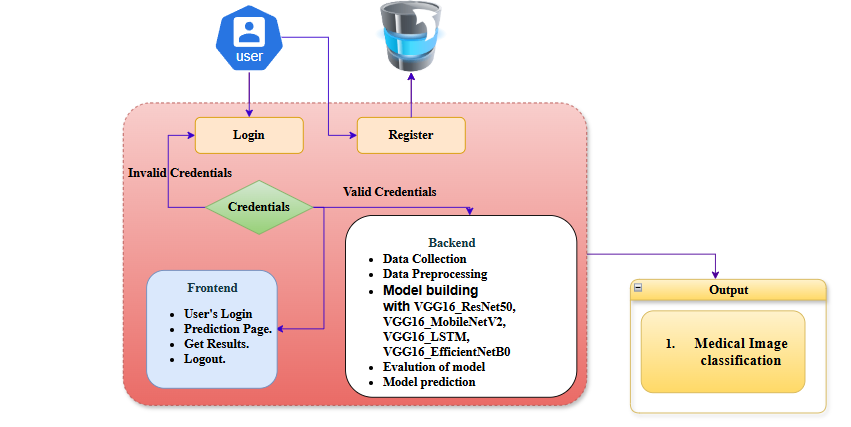
Block Diagram
Specifications
SOFTWARE REQUIREMENS
Operating System : Windows 7/8/10
Server side Script : html,css,js
Programming Language : Python
Libraries : Django, Pandas, Torch, Keras, Sklearn,Numpy , Seaborn
IDE/Workbench : VSCode
Server Deployment : Xampp Server
Database : SQLite
HARDWARE REQUIREMENTS
Processor - I3/Intel Processor
RAM - 8GB (min)
Hard Disk - 128 GB
Key Board - Standard Windows Keyboard
Mouse - Two or Three Button Mouse
Monitor - Any


Related Projects
 Paper Publishing

Request Call Back
Would you like to receive a free callback now?
Choose the best time for callback:
Leave your message and we will contact you as soon as possible

6-2-85/B, Old Maternity Hospital Road, Thyagaraja Nagar, Tirupati, Andhra Pradesh – 517501
+91 9030333433
+91 9393939065
0877-2261612

Disclaimer - Takeoff Edu Group Projects are not associated or affiliated with IEEE in any way. The IEEE Projects mentioned here are mentioned in the context of student projects, whose ideas are derived from IEEE publications, not projects of or by IEEE.

