Integrated approach to assess the quality of river
Objective
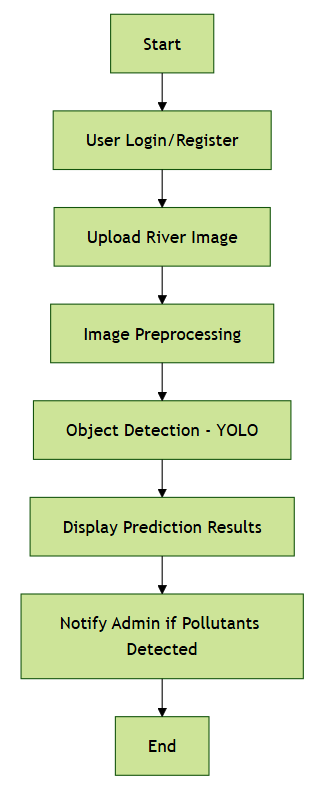
The project addresses water pollution by developing an automated system to assess river quality.It uses a dataset covering chemical pollutants, biological hazards, and visible waste like plastic, bottles, and metal.YOLOv8, YOLOv9, and YOLOv10 detect pollutants and objects in river images.The system is implemented with a Flask backend and a frontend built with HTML, CSS, and JavaScript.Users can register, log in, and upload images for analysis, with automated notifications sent to administrators through email.The framework combines object detection and user interaction for systematic monitoring and documentation.
Abstract
Water pollution is a critical concern affecting ecosystems and water quality. This project presents an integrated approach to assess river quality using automated detection of pollutants and objects present in water. The system utilizes a dataset containing various pollution types, including acid pollution, dead animals, eutrophication, fish oil, and plastic pollution, along with objects like bottles, cardboard, glass, metal, leaves, paper, trash, and water containers. YOLOv10 and YOLOv8 and v9, an advanced object detection algorithm, is employed to identify these pollutants and objects in images of river water. The system is implemented using a Flask framework with a front-end developed in HTML, CSS, and JavaScript, and a Python back-end for processing. Users can register, log in, and access a detection module that analyzes uploaded images for pollutants. Detected pollution instances can trigger automated notifications to the administrator, enabling effective monitoring. This approach allows systematic evaluation of water quality, highlighting areas affected by different types of contamination. By combining object detection and user interaction modules, the project provides a framework for assessing and documenting water conditions. The methodology can be extended to other water sources and environmental studies.
Keywords: water quality, river pollution, YOLOv10, object detection, acid pollution, plastic pollution, eutrophication, fish oil, Flask, automated monitoring
NOTE: Without the concern of our team, please don't submit to the college. This Abstract varies based on student requirements.
Block Diagram
Specifications
H/W CONFIGURATION:
Processor - I3/Intel Processor
Hard Disk - 160GB
Key Board - Standard Windows Keyboard
Mouse - Two or Three Button Mouse
Monitor - SVGA
RAM - 8GB
S/W CONFIGURATION:
• Operating System : Windows 7/8/10
• Server-side Script : HTML, CSS, Bootstrap & JS
• Programming Language : Python
• Libraries : Flask, Pandas, MySQL. Connector, Scikit-Learn,
• IDE/Workbench : VS Code
• Technology : Python 3.8+
• Server Deployment : Xampp Server


Related Projects
 Paper Publishing

Request Call Back
Would you like to receive a free callback now?
Choose the best time for callback:
Leave your message and we will contact you as soon as possible

6-2-85/B, Old Maternity Hospital Road, Thyagaraja Nagar, Tirupati, Andhra Pradesh – 517501
+91 9030333433
+91 9393939065
0877-2261612

Disclaimer - Takeoff Edu Group Projects are not associated or affiliated with IEEE in any way. The IEEE Projects mentioned here are mentioned in the context of student projects, whose ideas are derived from IEEE publications, not projects of or by IEEE.

