Innovating for Sustainability Driving Smart Resource Conservation in Home Appliances
Objective
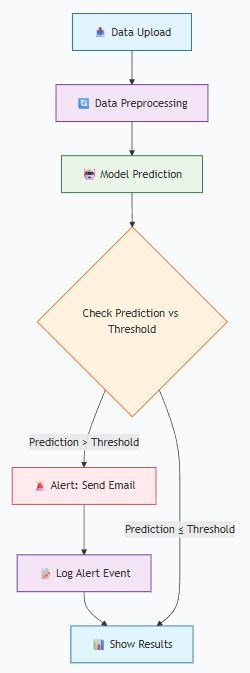
The primary objective of this project is to build a system that predicts home appliance energy consumption using historical and environmental data. It applies multiple machine learning models—Linear Regression, Support Vector Regressor, Random Forest Regressor, and XGBoost Regressor—to compare prediction accuracy and identify the most reliable approach. The project also includes data preprocessing, such as handling missing values and feature scaling, to improve performance. A web-based interface will allow users to upload data and view predictions through an interactive dashboard and alert system using mail if consumption is out of threshold. Overall, the system aims to support energy monitoring, highlight high-consumption periods, and promote efficient resource management through accurate and user-friendly predictive modeling.
Abstract
The project focuses on improving energy management in home appliances using predictive modeling and data analysis. It uses historical appliance usage and environmental data to forecast energy consumption patterns. Four machine learning algorithms Linear Regression, Support Vector Regressor, Random Forest Regressor, and XGBoost Regressor are applied to train models and compare their performance. The system is designed as a web-based application using a Flask framework, allowing users to upload data and generate forecasts. The dashboard presents energy consumption insights in an organized manner, enabling effective monitoring and management of resources. Data preprocessing ensures accuracy by handling missing values and scaling features. Model evaluation uses error metrics to select the most reliable algorithm. By predicting energy usage, the system supports better planning and reduces unnecessary resource consumption. The modular design includes data upload, and prediction functionalities, ensuring ease of use and maintainability. The project demonstrates the integration of machine learning techniques with web-based tools to facilitate smart resource conservation. The methodology combines data analysis, algorithmic modeling, and interactive visualization to provide actionable insights. The results indicate that ensemble and boosting methods often outperform linear models in prediction accuracy. The project lays a foundation for further development in intelligent resource management applications.
Keywords: energy consumption, machine learning, Linear Regression, SVR, Random Forest, XGBoost, prediction, data analysis, resource conservation, Flask.
NOTE: Without the concern of our team, please don't submit to the college. This Abstract varies based on student requirements.
Block Diagram
Specifications
3.1 Hardware Requirements
Processor - I3/Intel Processor
Hard Disk - 160GB
Key Board - Standard Windows Keyboard
Mouse - Two or Three Button Mouse
Monitor - SVGA
RAM - 8GB
3.2 Software Requirements
Operating System : Windows 7/8/10
Programming Language : Python
Libraries : Pandas, Numpy, scikit-learn.
IDE/Workbench : Visual Studio Code.
Framework : Flask


Related Projects
 Paper Publishing

Request Call Back
Would you like to receive a free callback now?
Choose the best time for callback:
Leave your message and we will contact you as soon as possible

6-2-85/B, Old Maternity Hospital Road, Thyagaraja Nagar, Tirupati, Andhra Pradesh – 517501
+91 9030333433
+91 9393939065
0877-2261612

Disclaimer - Takeoff Edu Group Projects are not associated or affiliated with IEEE in any way. The IEEE Projects mentioned here are mentioned in the context of student projects, whose ideas are derived from IEEE publications, not projects of or by IEEE.

