Improving Digital FORENSIC SECURITY: A Secure Storage Model With Authentication And Optimal Key Generation Based Encryption
Objective
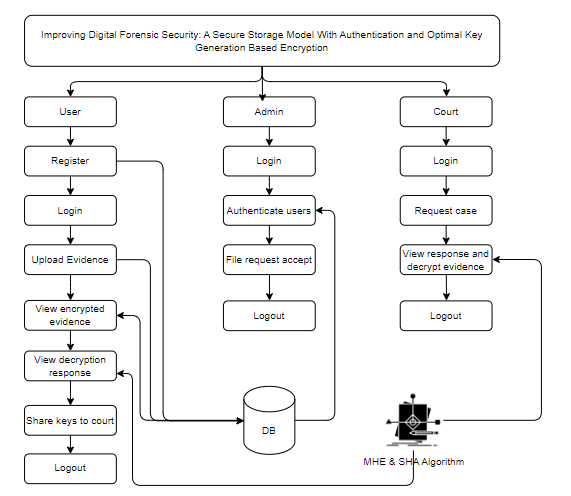
The DFA-AOKGE architecture boosts digital evidence security in cloud environments using BC-distributed data allocation, SBVM authentication, and EEO for key generation, ensuring confidentiality and integrity through Multikey Homomorphic Encryption.
Abstract
In digital forensics, ensuring the secure storage of digital evidence is crucial. This paper introduces a new method that uses advanced encryption and key generation techniques to protect digital evidence throughout an investigation. Cloud forensics, a modern approach to digital forensics, aims to safeguard evidence from online hacking. However, storing all evidence in one central location can reduce its reliability. To address this, we propose a digital forensics architecture for cloud platforms, specifically Infrastructure as a Service (IaaS). This architecture is designed to make it easier to collect and protect digital evidence while maintaining its integrity and origin in cloud computing environments. Our approach, called DFA-AOKGE (Digital Forensic Architecture with Authentication and Optimal Key Generation Encryption), uses a decentralized system to distribute data across multiple peers for collection and secure storage. For authentication, the DFA-AOKGE model uses a Secure Block Verification Mechanism (SBVM). It also generates secret keys using an Enhanced Equilibrium Optimizer (EEO) model. Data is encrypted using a multikey homomorphic encryption (MHE) method and then stored on the cloud server. Simulations show that the DFA-AOKGE method outperforms other recent approaches in various performance measures.
Keywords: Secure storage, digital forensics, encryption, key generation, cloud forensics, online hacking, centralized evidence, Infrastructure as a Service (IaaS), data integrity, digital objects, forensic investigations, Authentication with Optimal Key Generation Encryption (DFA-AOKGE), BC-distributed design, Secure Block Verification Mechanism (SBVM), Enhanced Equilibrium Optimizer (EEO), multikey homomorphic encryption (MHE), cloud server, simulation results, performance measures
NOTE: Without the concern of our team, please don't submit to the college. This Abstract varies based on student requirements.
Block Diagram
Specifications
Hardware Requirements
Processor - I3/Intel Processor
Hard Disk - 160GB
Key Board - Standard Windows Keyboard
Mouse - Two or Three Button Mouse
Monitor - SVGA
RAM - 8GB
Software Requirements:
Operating System : Windows 7/8/10
Server side Script : HTML, CSS, Bootstrap & JS
Programming Language : Python
Libraries : Django/Flask
Technology : Python 3.6+
Database : SQLITE/MySql/SQL


Related Projects
 Paper Publishing

Request Call Back
Would you like to receive a free callback now?
Choose the best time for callback:
Leave your message and we will contact you as soon as possible

6-2-85/B, Old Maternity Hospital Road, Thyagaraja Nagar, Tirupati, Andhra Pradesh – 517501
+91 9030333433
+91 9393939065
0877-2261612

Disclaimer - Takeoff Edu Group Projects are not associated or affiliated with IEEE in any way. The IEEE Projects mentioned here are mentioned in the context of student projects, whose ideas are derived from IEEE publications, not projects of or by IEEE.

