Implementation of Low-Density Parity-Check (LDPC) Codes in Verilog HDL
Also Available Domains Testing
Objective
1. To understand the structure and properties of LDPC codes and their advantages in error correction for digital communication systems. 2. To design and implement LDPC encoder and decoder modules in Verilog HDL for efficient hardware realization.
Abstract
Low-Density Parity-Check (LDPC) codes are powerful forward error correction (FEC) techniques widely used in modern communication systems due to their near-Shannon-limit performance. LDPC codes employ sparse parity-check matrices and iterative decoding algorithms to achieve high error correction capability with relatively low complexity. This project presents the design and implementation of an LDPC encoder and decoder using Verilog HDL, targeting efficient hardware realization for high-speed and low-power applications. The proposed design focuses on optimized parity-check matrix representation, parallel processing, and iterative decoding using message-passing algorithms. The architecture is suitable for FPGA and ASIC platforms and supports reliable data transmission in noise-prone communication environments.
NOTE: Without the concern of our team, please don't submit to the college. This Abstract varies based on student requirements.
Block Diagram
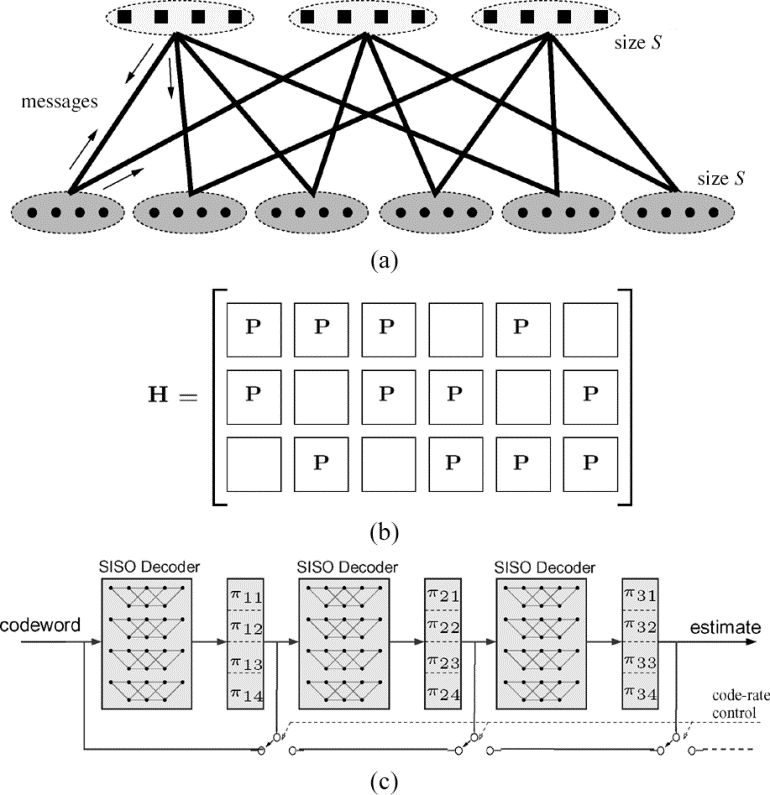
Specifications
Hardware Requirements
- Microsoft® Windows 10 / Windows 11 (64-bit)
- Intel® Core™ i5 / i7 Processor or equivalent
- Minimum 8 GB RAM
- Minimum 500 MB free disk space
Learning Outcomes
Understand LDPC coding principles and sparse matrix operations
Gain knowledge of hardware-based error correction techniques
Learn iterative decoding algorithms and message-passing concepts
Analyze trade-offs between speed, area, and power in VLSI design
Develop practical skills in Verilog HDL for communication systems


Related Projects
 Paper Publishing

Request Call Back
Would you like to receive a free callback now?
Choose the best time for callback:
Leave your message and we will contact you as soon as possible

6-2-85/B, Old Maternity Hospital Road, Thyagaraja Nagar, Tirupati, Andhra Pradesh – 517501
+91 9030333433
+91 9393939065
0877-2261612

Disclaimer - Takeoff Edu Group Projects are not associated or affiliated with IEEE in any way. The IEEE Projects mentioned here are mentioned in the context of student projects, whose ideas are derived from IEEE publications, not projects of or by IEEE.

