Implementation of an Enhanced RC6 Algorithm for Securing Data Using Verilog
Objective
Enhance Security over Standard RC6 • Implement a modified (or “enhanced”) version of RC6 such that its resistance to cryptanalysis (like differential or linear cryptanalysis) is improved. For example, some “enhanced RC6” variants use more complex diffusion or “box”-type operations to increase security. • Possibly introduce symmetric layers or additional algebraic transformations to break simple relationships, which strengthens the cipher.
Abstract
With the rapid advancement of digital communication and data storage, ensuring robust security mechanisms has become crucial. The RC6 encryption algorithm, an extension of the RC5 cipher, offers enhanced security and efficiency, making it suitable for high-speed cryptographic applications. This paper presents the implementation of an enhanced RC6 algorithm using Verilog, focusing on optimizing hardware efficiency, reducing latency, and increasing throughput. The proposed design leverages hardware acceleration techniques to improve encryption speed while maintaining strong resistance against cryptanalysis attacks. The Verilog-based implementation was synthesized and tested on an FPGA plat- form, demonstrating significant improvements in performance compared to conventional software-based encryption methods. Key performance metrics, including encryption/decryption speed, power consumption, and resource utilization, were analyzed to validate the effectiveness of the proposed design. Experimental results indicate that the optimized RC6 implementation achieves reduced execution time and lower power consumption, making it highly suitable for real-time security applications in embedded systems, IoT devices, and secure data transmission protocols. The study also compares the proposed architecture with existing FPGA-based cryptographic implementations to highlight its advantages in terms of scalability, flexibility, and resistance to attacks
Keywords:- Verilog, power efficiency, RC6 Algorithm, security.
NOTE: Without the concern of our team, please don't submit to the college. This Abstract varies based on student requirements.
Block Diagram
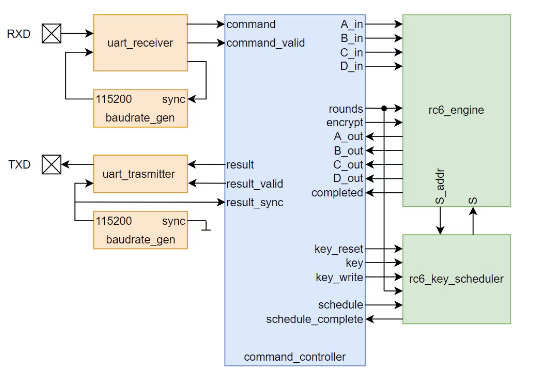
Specifications
Specifications:
Software Requirements:
· Xilinx ISE14.7 Suite/Vivado2018.3 Tool.
· HDL: Verilog.
Hardware Requirements:
· Microsoft® Windows XP.
· Intel® Pentium® 4 processor or Pentium 4 equivalent with SSE support.
· 512 MB RAM.
· 100 MB of available disk space.
Learning Outcomes
• Basics of Digital Electronics
• FPGA design Flow
• Introduction to Verilog Coding
• Different modeling styles in Verilog
o Data Flow modeling
o Structural modeling
o Behavioral modeling
o Mixed level modeling
• Drawbacks of existing methods
• Applications in real time
• Xilinx ISE 14.7/Xilinx Vivado for design and simulation
• Generation of Netlist
• Solution providing for real time problems
• Project Development Skills:
o Problem Analysis Skills
o Problem Solving Skills
o Logical Skills
o Designing Skills
o Testing Skills.
o Debugging Skills.
o Presentation Skills.
o Thesis Writing Skills


Related Projects
 Paper Publishing

Request Call Back
Would you like to receive a free callback now?
Choose the best time for callback:
Leave your message and we will contact you as soon as possible

6-2-85/B, Old Maternity Hospital Road, Thyagaraja Nagar, Tirupati, Andhra Pradesh – 517501
+91 9030333433
+91 9393939065
0877-2261612

Disclaimer - Takeoff Edu Group Projects are not associated or affiliated with IEEE in any way. The IEEE Projects mentioned here are mentioned in the context of student projects, whose ideas are derived from IEEE publications, not projects of or by IEEE.

