Identify Pattern for PixelLevel Segmentation of Lung Tumors in LDCT using Deep Learning
Objective
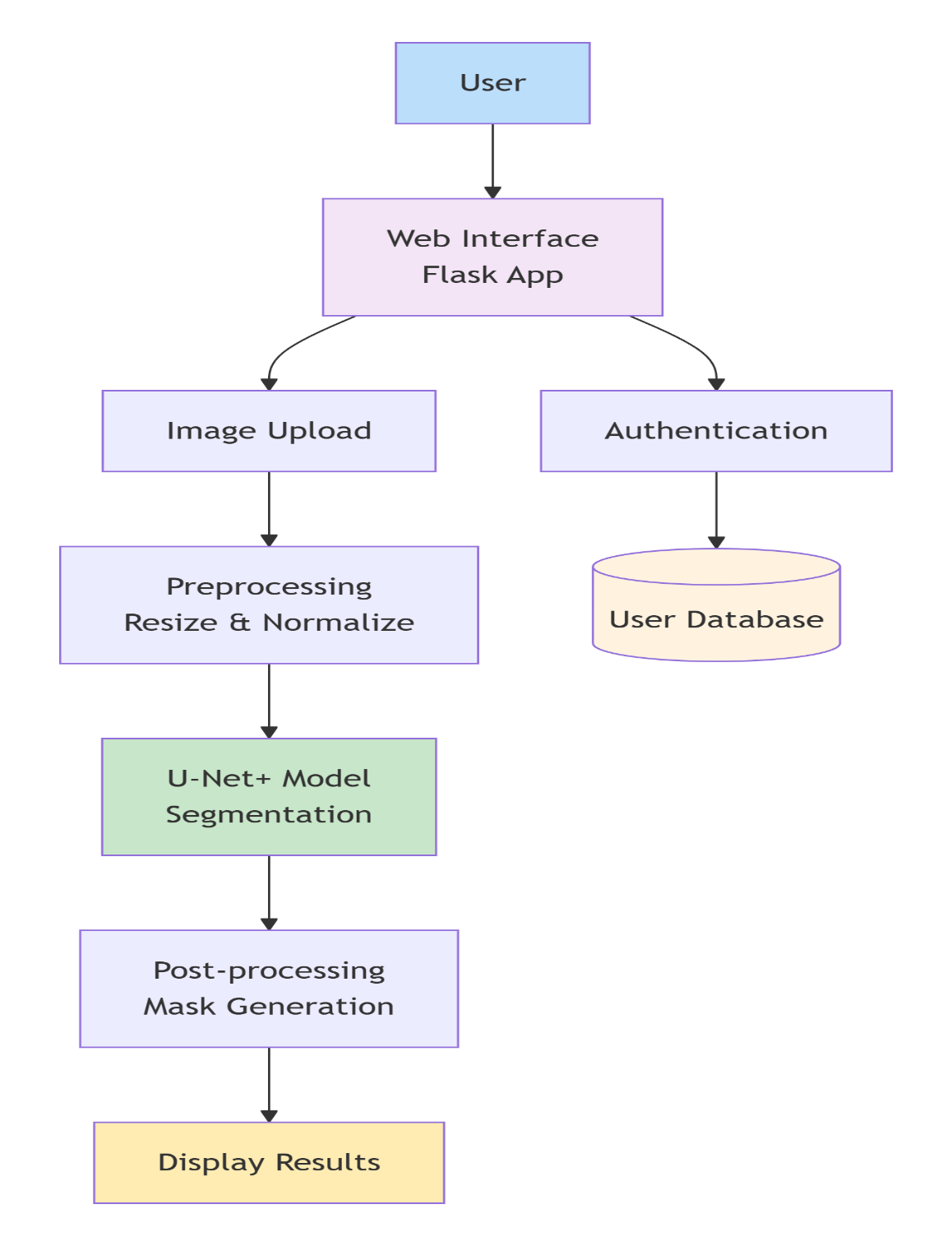
The primary objective of this project is to develop an effective deep learning-based system for pixel-level lung tumor segmentation using LDCT images. The project aims to utilize the U-Net+ architecture to accurately identify tumor boundaries and spatial patterns within lung scans.Specific objectives include preprocessing LDCT images to enhance data quality and consistency, training the U-Net+ model to learn meaningful feature representations, and evaluating segmentation performance using appropriate metrics. Another objective is to design a structured web application that allows users to interact with the segmentation model through a simple interface.The project also aims to ensure modular system design, enabling clear separation between user authentication, image processing, and segmentation functionality. By achieving these objectives, the research demonstrates the effectiveness of deep learning-based segmentation techniques for medical imaging and contributes to advancements in automated lung tumor analysis.
Abstract
Lung cancer is a major health concern due to challenges in early detection and complex tumor structures. Low-Dose Computed Tomography (LDCT) scans are commonly used for lung screening as they minimize radiation exposure while retaining critical lung details. However, manual analysis of LDCT images is time-consuming and may result in inconsistent outcomes because of variations in tumor appearance. This project presents a deep learning-based method for pixel-level lung tumor segmentation using the U-Net+ architecture, which enables accurate identification of tumor regions by learning spatial and contextual features directly from imaging data.
The proposed system applies image preprocessing techniques to enhance data quality and trains the U-Net+ model to achieve precise tumor boundary segmentation. Performance is evaluated using segmentation metrics such as Dice coefficient and Intersection over Union (IoU). A Flask-based web application is developed to allow users to upload LDCT images and visualize segmentation results through a secure interface. The findings indicate that U-Net+ effectively captures complex tumor patterns and provides reliable segmentation outcomes, supporting its use in lung tumor image analysis research.
Keywords: Lung Tumor Segmentation, LDCT Imaging, Deep Learning, U-Net+, Pixel-Level Segmentation, Medical Image Analysis, Convolutional Neural Networks, Flask Application, Image Processing
NOTE: Without the concern of our team, please don't submit to the college. This Abstract varies based on student requirements.
Block Diagram
Specifications
HARDWARE REQUIREMENTS
• Processor - I5/Intel Processor
• RAM - 8GB (min)
• Hard Disk - 160 GB
• Key Board - Standard Windows Keyboard
• Mouse - Two or Three Button Mouse
• Monitor - Any
SOFTWARE REQUIREMENS
• Operating System : Windows 7/8/10
• Server side Script : HTML, CSS, Bootstrap & JS
• Programming Language : Python
• Libraries : Flask, Pandas, Mysql.connector, Os, Numpy,
Scikit-learn.
• IDE/Workbench : VS-Code
• Technology : Python 3.10+
• Server Deployment : Xampp Server
• Database : MySQL


Related Projects
 Paper Publishing

Request Call Back
Would you like to receive a free callback now?
Choose the best time for callback:
Leave your message and we will contact you as soon as possible

6-2-85/B, Old Maternity Hospital Road, Thyagaraja Nagar, Tirupati, Andhra Pradesh – 517501
+91 9030333433
+91 9393939065
0877-2261612

Disclaimer - Takeoff Edu Group Projects are not associated or affiliated with IEEE in any way. The IEEE Projects mentioned here are mentioned in the context of student projects, whose ideas are derived from IEEE publications, not projects of or by IEEE.

