identification of Major Psychiatric Disorders From Resting State Electroencephalography Using a Machine Learning Approach
Objective
The objective of this project is to develop a machine learning-based classification system that leverages electroencephalography (EEG) data to detect and differentiate major psychiatric disorders. By utilizing quantitative EEG (QEEG) parameters such as power spectrum density (PSD) and functional connectivity (FC) across various frequency bands, the system aims to classify patients with disorders like mood disorders, addictive disorders, trauma and stress-related disorders, schizophrenia, and anxiety disorders. The project will employ algorithms like Support Vector Machine (SVM), Random Forest, and XGBoost for binary classification, with the ultimate goal of providing an accurate, automated tool for psychiatric disorder detection based on EEG data.
Abstract
This project focuses on the development of a machine learning (ML) classifier designed to detect and compare major psychiatric disorders using electroencephalography (EEG) data. The dataset consists of 945 subjects, including 850 patients with major psychiatric disorders (covering six large-categorical and nine specific disorders) and 95 healthy controls (HCs). The data includes intelligence quotient (IQ) scores, psychological assessment results, and quantitative EEG (QEEG) parameters recorded during resting-state assessments. By analyzing power spectrum density (PSD) and functional connectivity (FC) across different frequency bands, we developed ML models to classify and differentiate psychiatric disorders from healthy controls. Various algorithms, including Support Vector Machine (SVM), Random Forest, and XGBoost, were utilized to construct binary classification models for each disorder. The output of the system provides classifications for conditions such as mood disorders, addictive disorders, trauma and stress-related disorders, schizophrenia, and anxiety disorders. The technologies employed in this project include Python, Django, Scikit-learn, Imblearn, and SQLite for efficient data processing and model development.
Keywords: Psychiatric Disorders, Electroencephalography (EEG), Quantitative EEG (QEEG), Machine Learning, Power Spectrum Density (PSD), Functional Connectivity (FC), Support Vector Machine (SVM), Random Forest, XGBoost, Mental Health Classification.
NOTE: Without the concern of our team, please don't submit to the college. This Abstract varies based on student requirements.
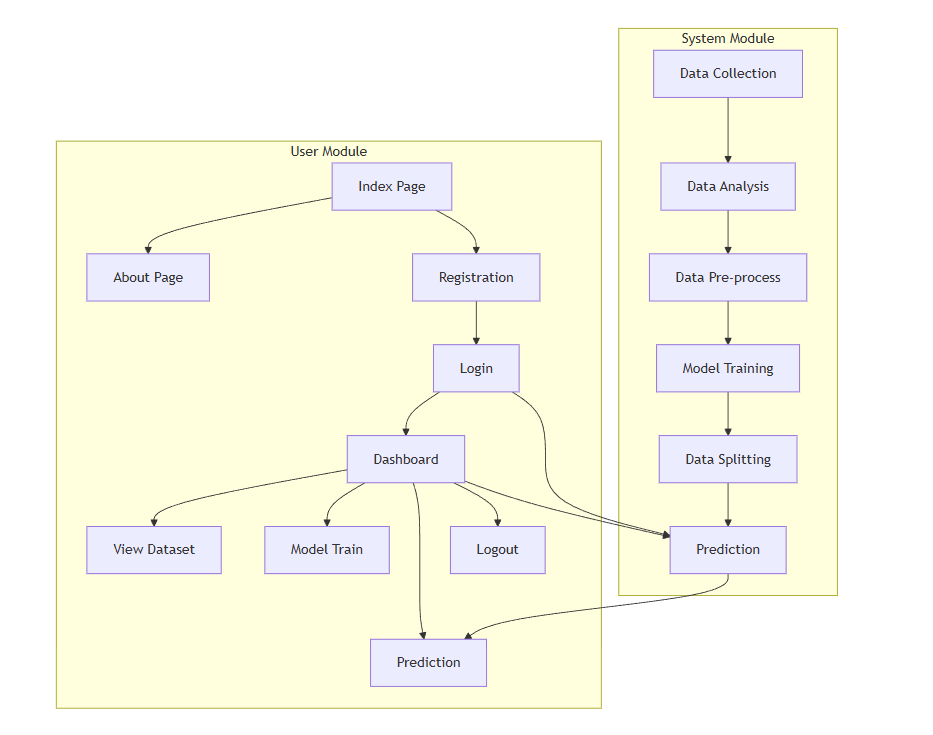
Block Diagram
Specifications
Hardware Requirements
Processor - I3/Intel Processor
Hard Disk - 160GB
Key Board - Standard Windows Keyboard
Mouse - Two or Three Button Mouse
Monitor - SVGA
RAM - 8GB
Software Requirements:
Operating System : Windows 7/8/10
Server side Script : HTML, CSS, Bootstrap & JS
Programming Language : Python
Libraries : Django, Pandas, Numpy, Tensorflow, Scikit-learn.
IDE/Workbench : VS Code
Technology : Python 3.10
Database : SQLite


Related Projects
 Paper Publishing

Request Call Back
Would you like to receive a free callback now?
Choose the best time for callback:
Leave your message and we will contact you as soon as possible

6-2-85/B, Old Maternity Hospital Road, Thyagaraja Nagar, Tirupati, Andhra Pradesh – 517501
+91 9030333433
+91 9393939065
0877-2261612

Disclaimer - Takeoff Edu Group Projects are not associated or affiliated with IEEE in any way. The IEEE Projects mentioned here are mentioned in the context of student projects, whose ideas are derived from IEEE publications, not projects of or by IEEE.

