Health Care Supply Chain Security with Zero Knowledge Prof Authentication in Blockchain for Personalized Health Monitoring
Objective
The primary objective of implementing "Block chain for the Management of Internet of Things Devices in the Medical Industry" is to address critical challenges in healthcare by leveraging block chain technology. The goal is to enhance data security and privacy, safeguarding sensitive patient information collected by IoT devices against unauthorized access and data breaches. Furthermore, the objective is to ensure the integrity of medical data through the immutability of the block chain ledger, providing a reliable and tamper-proof source of truth for healthcare information. Additionally, the implementation aims to promote interoperability, offering a standardized platform for diverse IoT devices to seamlessly communicate and share data, ultimately streamlining healthcare processes, ensuring regulatory compliance, and improving the overall quality of patient care.
Abstract
With the recent emergence of the smart healthcare era, and patients relying more on personalized health monitoring based on Internet of Medical Things (IoMT) devices; patients’ lives are becoming highly threatened in case they fall victim to counterfeit devices. Thus, verifying whether these body sensors utilized are authentic and reliable in an unimpeachable, credible, and auditable manner without any centralized management is of crucial importance. Furthermore, manipulating data and hijacking in an IoMT context are also of tremendous criticality. Motivated by the aforementioned challenges, in this article, a smart contract- based scalable authentication scheme dedicated for IoMT devices is proposed. The scheme mitigates the deficiencies of the traditional established systems that are extensively built on centralized ap- proaches, vulnerable to distributed denial of service attacks, by leveraging blockchain’s decentralization and security properties. The scheme ensures confidentiality, anonymity, and privacy as it is built on a consortium blockchain and integrity by offering secure firmware updates and protects patients from counterfeit devices by leveraging the physical unclonable function. The authentica-tion approach was implemented on Ethereum and evaluated with regard to its computation and communication costs to prove its feasibility and effectiveness as well as its security by presenting a formal analysis using ProVerif.
Keywords: Authentication, block chain, counterfeit, healthcare, Internet of Things (IoT), privacy, security.
NOTE: Without the concern of our team, please don't submit to the college. This Abstract varies based on student requirements.
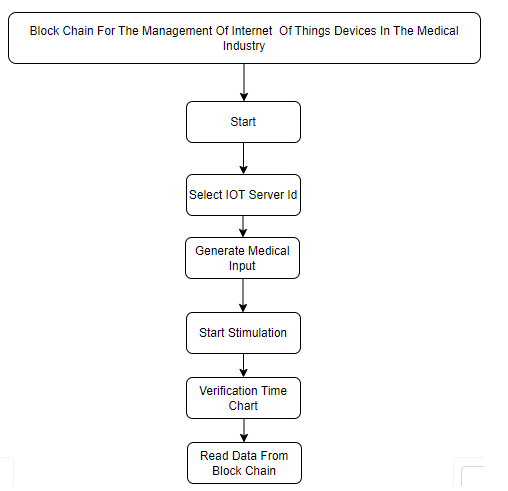
Block Diagram
Specifications
H/W CONFIGURATION:
Processor - I3/Intel Processor
Hard Disk - 160GB
Key Board - Standard Windows Keyboard
Mouse - Two or Three Button Mouse
Monitor - SVGA
RAM - 8GB
S/W CONFIGURATION:
• Operating System : Windows 7/8/10
• Server side Script : HTML, CSS, Bootstrap & JS
• Programming Language : Python
• Libraries : Flask, Pandas, Mysql.connector, Os, Smtplib, Numpy
• IDE/Workbench : PyCharm
• Technology : Python 3.6+
• Server Deployment : Xampp Server


Related Projects
 Paper Publishing

Request Call Back
Would you like to receive a free callback now?
Choose the best time for callback:
Leave your message and we will contact you as soon as possible

6-2-85/B, Old Maternity Hospital Road, Thyagaraja Nagar, Tirupati, Andhra Pradesh – 517501
+91 9030333433
+91 9393939065
0877-2261612

Disclaimer - Takeoff Edu Group Projects are not associated or affiliated with IEEE in any way. The IEEE Projects mentioned here are mentioned in the context of student projects, whose ideas are derived from IEEE publications, not projects of or by IEEE.

