HARDWARE TROJAN IDENTIFICATION AND STOPPAGE
Objective
"The objective of this project is to develop an advanced and efficient hardware Trojan detection system using state-of-the-art machine learning algorithms. Hardware Trojans, being malicious modifications in integrated circuits, pose significant security threats, potentially leading to unauthorized data access, system failures, or catastrophic breaches in critical infrastructures. Traditional detection approaches, such as Support Vector Machines (SVM), k-Nearest Neighbors (KNN), and Logistic Regression, have exhibited limited accuracy and reliability, failing to address the increasing complexity of hardware designs and Trojan implementations. To overcome these limitations, this project seeks to implement and evaluate advanced machine learning techniques, including Convolutional Neural Networks (CNN), Random Forest, XGBoost, and Decision Trees. These algorithms are selected for their superior capabilities in feature extraction, classification, and handling large datasets, essential for identifying anomalies indicative of hardware Trojans. The primary aim is to enhance detection accuracy, reduce false positives and negatives, and ensure a scalable solution adaptable to diverse hardware scenarios. "
Abstract
HARDWARE TROJAN IDENTIFICATION AND STOPPAGE
Abstract:
The increasing complexity and globalization of hardware manufacturing have heightened the risk of hardware Trojans (HTs), which pose significant threats to the security and integrity of electronic systems. Traditional detection methods, including Support Vector Machines (SVM), k-Nearest Neighbors (KNN), and Logistic Regression, have demonstrated limited accuracy and reliability in distinguishing between benign and malicious hardware. This project proposes a robust solution by leveraging advanced machine learning algorithms such as Convolutional Neural Networks (CNN), Random Forest, XGBoost, and Decision Tree models. These algorithms are specifically chosen for their proven capabilities in handling large datasets, feature extraction, and classification tasks, which are crucial for detecting hardware Trojans effectively.
The proposed system aims to enhance prediction accuracy and computational efficiency by employing state-of-the-art techniques to analyze circuit behavior and identify anomalies indicative of HTs. A hybrid approach combining feature engineering and deep learning is implemented to address the limitations of existing models. Experimental evaluations demonstrate the proposed system's superior performance in distinguishing between benign and Trojan-infected hardware, ensuring improved reliability and security in hardware manufacturing and deployment.
This project provides a significant contribution to the domain of hardware security by offering an accurate, efficient, and scalable solution for hardware Trojan detection. The results of this study can benefit industries and research communities by mitigating risks associated with compromised hardware systems.
Keywords: Hardware Trojan, Machine Learning, Convolutional Neural Networks (CNN), Random Forest, XGBoost, Decision Tree, Hardware Security, Anomaly Detection, Advanced Algorithms.
NOTE: Without the concern of our team, please don't submit to the college. This Abstract varies based on student requirements.
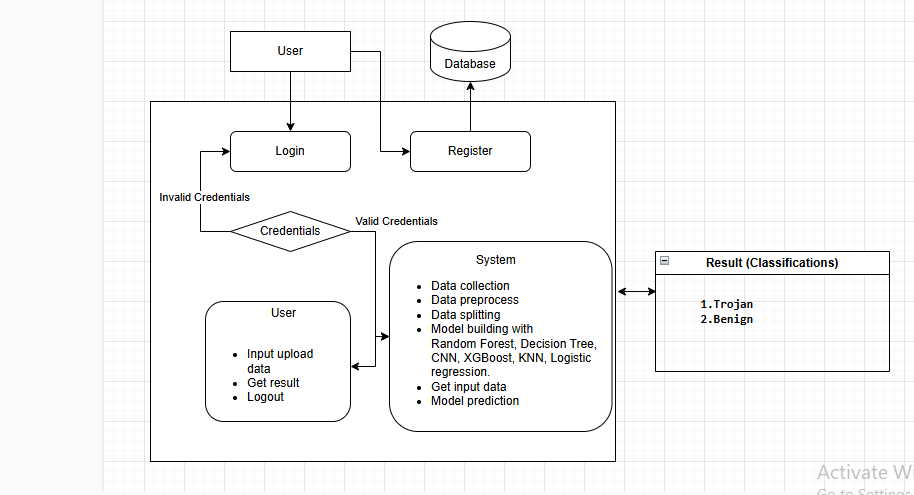
Block Diagram
Specifications
SYSTEM SPECIFICATIONS:
H/W SPECIFICATIONS:
· Processor : I5/Intel Processor
· RAM : 8GB (min)
· Hard Disk : 128 GB
· Key Board : Standard Windows Keyboard
· Mouse : Two or Three Button Mouse
· Monitor : Any
S/W SPECIFICATIONS:
• Operating System : Windows 7+
• Server-side Script : Python 3.6+
• IDE : PyCharm / VSCode
• Libraries Used : Pandas, Numpy, Matplotlib, OS.


Related Projects
 Paper Publishing

Request Call Back
Would you like to receive a free callback now?
Choose the best time for callback:
Leave your message and we will contact you as soon as possible

6-2-85/B, Old Maternity Hospital Road, Thyagaraja Nagar, Tirupati, Andhra Pradesh – 517501
+91 9030333433
+91 9393939065
0877-2261612

Disclaimer - Takeoff Edu Group Projects are not associated or affiliated with IEEE in any way. The IEEE Projects mentioned here are mentioned in the context of student projects, whose ideas are derived from IEEE publications, not projects of or by IEEE.

