Glacial Lake Outburst Floods
Objective
The primary objective of this project is to create an advanced machine learning model capable of predicting Glacial Lake Outburst Floods (GLOFs) with high accuracy. By utilizing a synthetic dataset, the project aims to build a predictive system that incorporates key factors such as lake volume, glacier meltwater contribution, environmental conditions, seismic activity, and historical data. The system will utilize machine learning algorithms like Decision Tree, Random Forest, and XGBoost to analyze these variables and provide timely predictions of potential GLOF occurrences
Abstract
The "Glacial Lake Outburst Floods (GLOFs) Prediction using Machine Learning" project aims to predict the occurrence of GLOFs based on various lake, glacier, environmental, and geospatial characteristics using machine learning models. The system utilizes a synthetic dataset that includes crucial factors such as lake volume, water level, glacier meltwater contribution, temperature, precipitation, wind speed, seismic activity, and past flood events. Additionally, geospatial data like elevation and proximity to fault lines are incorporated for enhanced prediction accuracy. Machine learning algorithms including Decision Tree, Random Forest, and XGBoost are employed to build a predictive model that analyzes these factors and estimates the likelihood of a GLOF occurring.
The project is designed to assist in disaster preparedness and management by providing timely warnings of potential flood events, based on real-time and historical data. The system is built using Python for the backend, with Flask as the framework, while the frontend is developed using HTML, CSS, and JavaScript to offer a user-friendly interface. This solution offers valuable insights for monitoring glacial lakes and mitigating the risks of catastrophic flooding in vulnerable regions. The predictive model can help prioritize resources, enhance safety measures, and contribute to a more resilient infrastructure in areas prone to glacial lake outburst floods.
Keywords: GLOF prediction, machine learning, Decision Tree, Random Forest, XGBoost, synthetic dataset, glacial lake characteristics, environmental conditions, disaster management, Flask, real-time prediction, geospatial data.
NOTE: Without the concern of our team, please don't submit to the college. This Abstract varies based on student requirements.
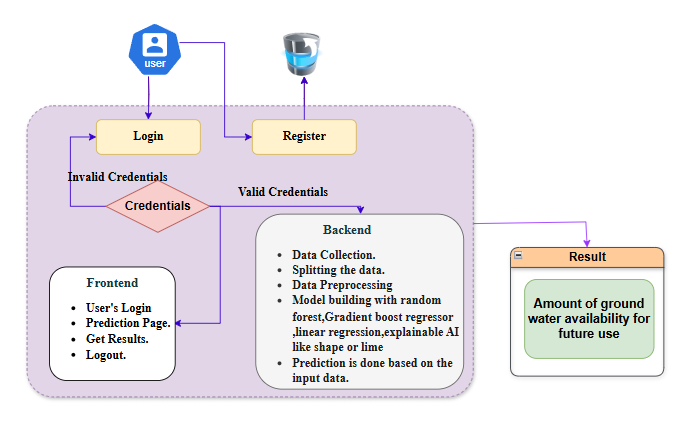
Block Diagram
Specifications
· Processor : I5/Intel Processor
· RAM : 8GB (min)
· Hard Disk : 128 GB
S/W Specifications:
• Operating System : Windows 10
• Server-side Script : Python 3.6
• IDE : PyCharm, Jupyter notebook
• Libraries Used : Numpy, IO, OS, Flask, Keras, pandas, tensorflow

Demo Video


Request for Video
Related Projects
 Paper Publishing
Request Call Back
Would you like to receive a free callback now?
Choose the best time for callback:
Leave your message and we will contact you as soon as possible

6-2-85/B, Old Maternity Hospital Road, Thyagaraja Nagar, Tirupati, Andhra Pradesh – 517501
+91 9030333433
+91 9393939065
0877-2261612

Disclaimer - Takeoff Edu Group Projects are not associated or affiliated with IEEE in any way. The IEEE Projects mentioned here are mentioned in the context of student projects, whose ideas are derived from IEEE publications, not projects of or by IEEE.

