Generative ai driven predictive autoscaling framework for cloud native application
Objective
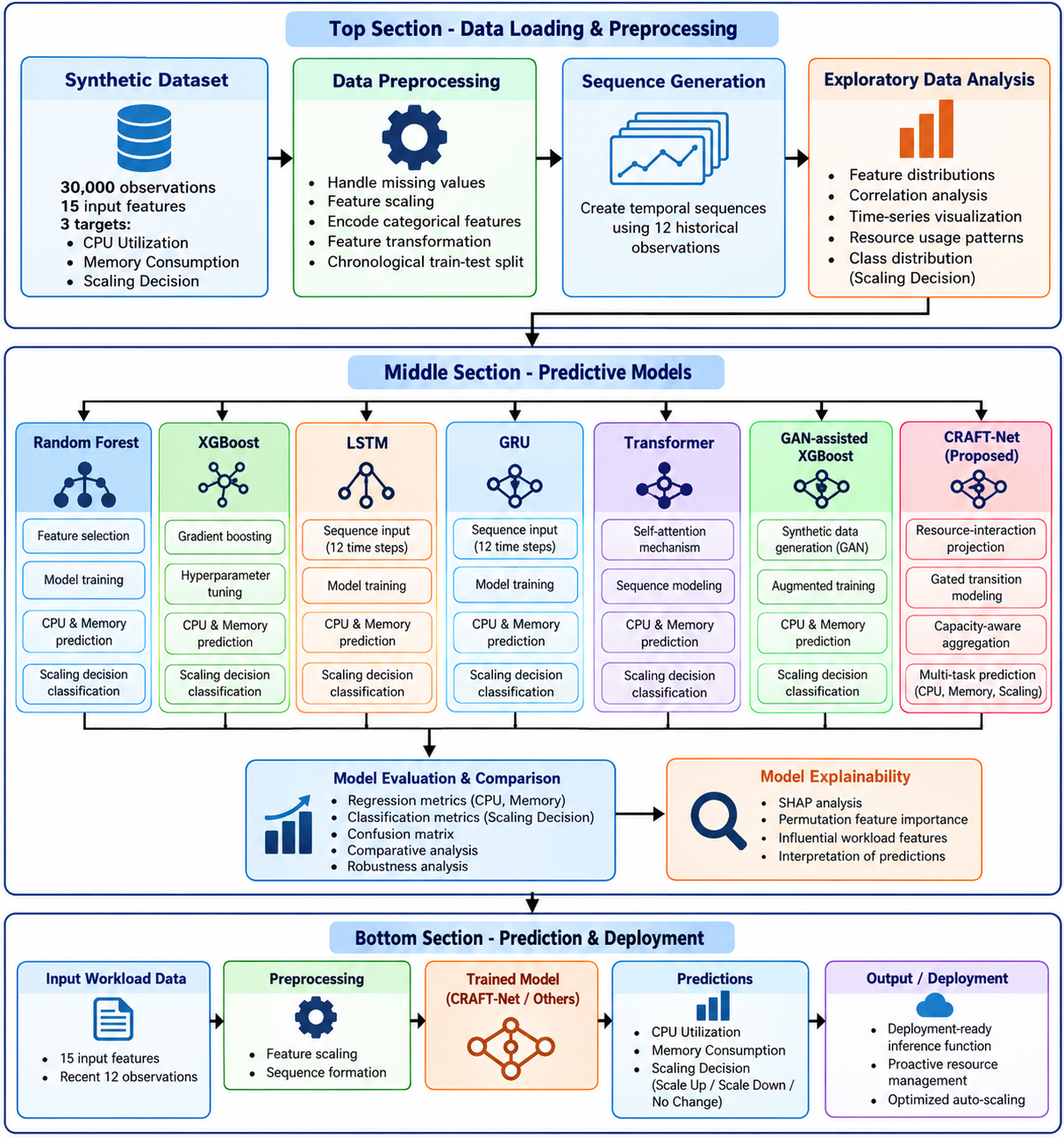
The proposed project develops an intelligent cloud-native predictive autoscaling system using machine learning and deep learning techniques to optimize resource utilization and scaling decisions. The framework integrates Random Forest, XGBoost, LSTM, GRU, Transformer, GAN-XGBoost, and the proposed CRAFT-Net with data preprocessing, feature engineering, normalization, and model evaluation. The system uses a synthetic cloud workload dataset containing 30,000 observations and 15 input features. The proposed CRAFT-Net combines resource-interaction projection, gated temporal modeling, capacity-conditioned aggregation, and joint prediction heads to predict CPU utilization, memory consumption, and scaling actions classified as Scale Up, Scale Down, and No Change. Model performance is evaluated using Accuracy, Balanced Accuracy, F1-score, MAE, RMSE, R², and Confusion Matrix. SHAP and permutation importance provide model explainability. The trained models and evaluation results are saved to support automated cloud resource management and predictive autoscaling.
Abstract
The rapid growth of cloud-native applications has increased the demand for intelligent resource management and predictive auto-scaling systems capable of handling dynamic workloads and fluctuating resource utilization. Traditional auto-scaling techniques often face challenges in predicting resource requirements, identifying workload variations, and making efficient scaling decisions. This project proposes an intelligent cloud-native predictive auto-scaling framework using a synthetic dataset containing 30,000 workload observations with 15 input features and three prediction targets. The framework integrates six baseline approaches, Random Forest, XGBoost, Long Short-Term Memory (LSTM), Gated Recurrent Unit (GRU), Transformer, and Conditional Generative Adversarial Network (GAN) with XGBoost, alongside a proposed novel architecture, Causal Resource-Adaptive Forecasting and Transition Network (CRAFT-Net). The proposed architecture combines trainable resource-interaction projection, gated resource-transition learning, capacity-conditioned transition aggregation, and multi-task prediction to identify meaningful relationships between workload behavior and resource requirements. The system analyzes CPU consumption, memory consumption, request rate, network usage, workload intensity, historical resource utilization, and container performance metrics to forecast CPU and memory utilization for the next five minutes. Furthermore, the proposed model incorporates a capacity-pressure consistency mechanism to support intelligent scaling decisions categorized as Scale Up, Scale Down, and No Change. The framework aims to overcome the limitations of conventional resource management approaches by integrating temporal workload analysis, adaptive resource forecasting, and capacity-aware scaling intelligence. The proposed system provides a structured approach toward developing efficient, adaptive, and intelligent predictive auto-scaling solutions for modern cloud-native environments.
Keywords: Cloud-Native Computing, Predictive Auto-Scaling, CRAFT-Net, Resource Utilization Forecasting, Machine Learning, Deep Learning, LSTM, GRU, Transformer, XGBoost, Generative Adversarial Network, Intelligent Resource Management.
NOTE: Without the concern of our team, please don't submit to the college. This Abstract varies based on student requirements.
Block Diagram
Specifications
HARDWARE REQUIREMENTS
Processor - I3/Intel Processor
Hard Disk - 160GB
Key Board - Standard Windows Keyboard
Mouse - Two or Three Button Mouse
Monitor - SVGA
RAM - 8GB
SOFTWARE REQUIREMENTS:
Operating System : Windows 7/8/10
Server side Script : HTML, CSS
Programming Language : Python
Libraries : Flask, Pandas, sqllite, NumPy
IDE/Workbench : VsCode
Technology : Python 3.10+
Database : sqllite


Related Projects
 Paper Publishing


Request Call Back
Would you like to receive a free callback now?
Choose the best time for callback:
Leave your message and we will contact you as soon as possible

6-2-85/B, Old Maternity Hospital Road, Thyagaraja Nagar, Tirupati, Andhra Pradesh – 517501
+91 9030333433
+91 9393939065
0877-2261612

Disclaimer - Takeoff Edu Group Projects are not associated or affiliated with IEEE in any way. The IEEE Projects mentioned here are mentioned in the context of student projects, whose ideas are derived from IEEE publications, not projects of or by IEEE.