FPGA Implementation Of Dynamic Power, Area Optimized Reversible ALU For Various DSP Applications
Objective
Reversible logic is increasingly applied in circuits due to its ability to reduce energy dissipation by theoretically minimizing information loss, which is a major source of power consumption. This ALU aims to leverage reversible gates to dynamically reduce power usage, making it suitable for energy-sensitive DSP applications.
Abstract
The challenge of power dissipation in electronic products utilizing chips, emphasizing the need for efficient power-reducing architectures to lower maintenance costs. It identifies embedded devices, graphical processors, and DSP processors as particularly affected by low power concerns. The Arithmetic Logic Unit (ALU) is singled out as a critical component in these systems, tasked with consuming minimal power and space while maintaining high-speed operations and accuracy. The paper proposes the design and implementation of an ALU using reversible logic gates as a means to reduce power consumption. Reversible logics are known for their ability to minimize energy dissipation. The objective is to compare the power consumption and area of traditional ALUs with those using reversible logic gates enabling a comprehensive evaluation of their efficiency and effectiveness in addressing power dissipation challenges both architectures are developed using Verilog HDL Using the Artix 7 board and Xilinx VIVADO
Keywords— Reversible logic gates, FPGA (Field Programmable Gate Array), Quantum cost.
NOTE: Without the concern of our team, please don't submit to the college. This Abstract varies based on student requirements.
Block Diagram
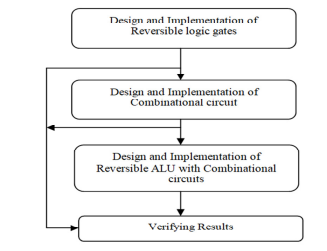
Specifications
Software Requirements:
VIVADO 2018.3
Hardware Requirements:
· Microsoft® Windows XP
· Intel® Pentium® 4 processor or Pentium 4 equivalent with SSE support
· 512 MB RAM
· 100 MB of available disk space
Learning Outcomes
- Basics of Digital Electronics
- VLSI design Flow
- Applications in real time
· VIVADO for design and simulation
· Solution providing for real time problems
· Project Development Skills:
o Problem Analysis Skills
o Problem Solving Skills
o Logical Skills
o Designing Skills
o Testing Skills
o Debugging Skills
o Presentation Skills
o Thesis Writing Skills
Demo Video


Request for Video
Related Projects
 Paper Publishing
Request Call Back
Would you like to receive a free callback now?
Choose the best time for callback:
Leave your message and we will contact you as soon as possible

6-2-85/B, Old Maternity Hospital Road, Thyagaraja Nagar, Tirupati, Andhra Pradesh – 517501
+91 9030333433
+91 9393939065
0877-2261612

Disclaimer - Takeoff Edu Group Projects are not associated or affiliated with IEEE in any way. The IEEE Projects mentioned here are mentioned in the context of student projects, whose ideas are derived from IEEE publications, not projects of or by IEEE.

