FPGA Based Real Time ECG Signal Filtering and Abnormality Detection Using UART Communication and Mac
Objective
This project presents a complete hardware–software co-design framework for real-time electrocardiogram (ECG) monitoring and cardiac abnormality detection using FPGA-based data acquisition and Raspberry Pi-based machine learning classification. The proposed system integrates MATLAB signal preparation, FPGA memory interfacing, serial communication, and intelligent classification into a unified biomedical diagnostic platform
Abstract
This project presents a complete hardware–software co-design framework for real-time electrocardiogram (ECG) monitoring and cardiac abnormality detection using FPGA-based data acquisition and Raspberry Pi-based machine learning classification. The proposed system integrates MATLAB signal preparation, FPGA memory interfacing, serial communication, and intelligent classification into a unified biomedical diagnostic platform. ECG samples obtained from a dataset are first converted into hexadecimal memory initialization data (COE format) using MATLAB and stored inside FPGA Block RAM. The FPGA sequentially reads the ECG samples and transmits them through UART communication to a Raspberry Pi processor without software intervention. The Raspberry Pi reconstructs the ECG waveform in real time and applies a Random Forest classifier to determine whether the cardiac activity corresponds to a normal or abnormal condition.
The architecture divides the computational workload between deterministic hardware communication and intelligent software analysis. The FPGA performs high-speed and low-latency data streaming, while the Raspberry Pi executes pattern recognition and classification. Experimental results demonstrate reliable transmission of ECG samples, accurate waveform reconstruction, and successful detection of cardiac abnormalities. The system achieves real-time monitoring capability with reduced processor overhead and improved responsiveness compared to traditional PC-based processing methods. The proposed design validates FPGA-assisted biomedical monitoring as an effective solution for portable and remote healthcare applications. The platform can be extended to wearable patient monitoring devices and continuous telemedicine diagnosis systems.
Keywords: ECG Monitoring, FPGA, UART Communication, Raspberry Pi, Random Forest, Machine Learning, Biomedical Embedded Systems, Real-Time Diagnosis, Hardware-Software Co-Design, Cardiac Abnormality Detection
NOTE: Without the concern of our team, please don't submit to the college. This Abstract varies based on student requirements.
Block Diagram
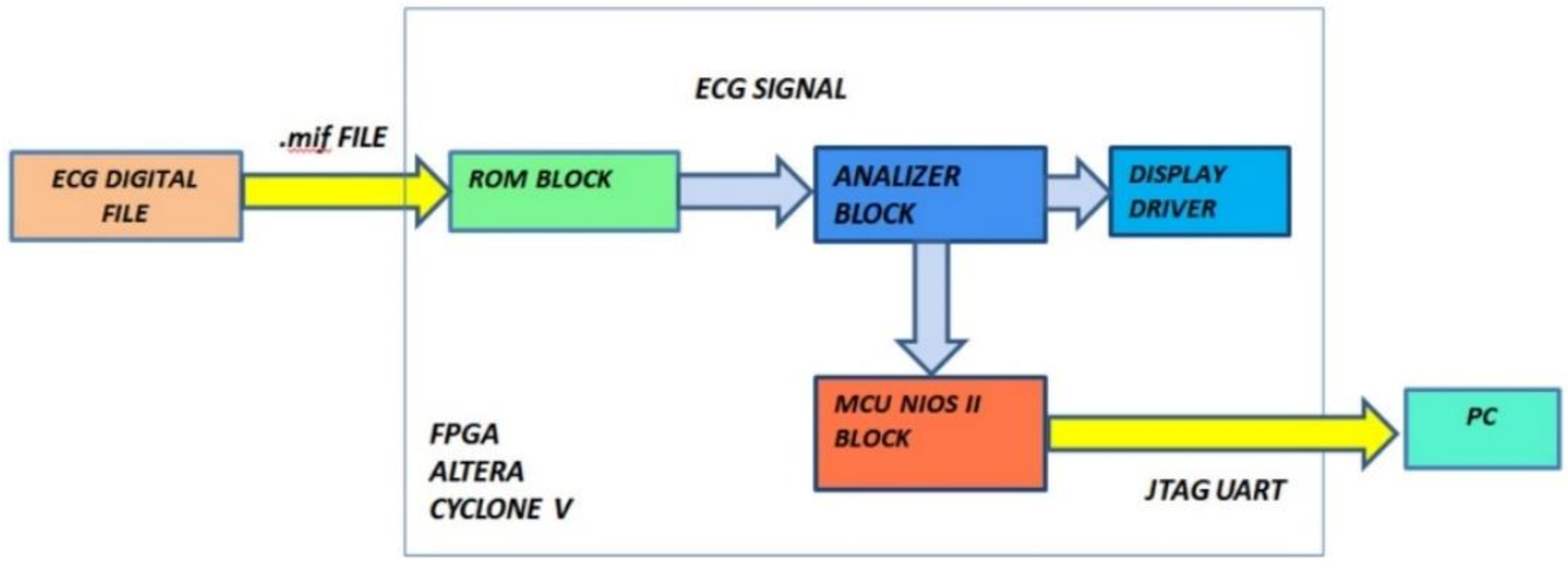
Specifications
Specifications
Software Requirements
• MATLAB
• Xilinx Vivado
• Python (Machine Learning)
Hardware Requirements
• Basys-3 FPGA
• Raspberry Pi
• UART Interface
Learning Outcomes
• FPGA Communication Design
• Biomedical Signal Handling
• Embedded Machine Learning
• Real-Time System Development
• IoT Healthcare Applications
Demo Video


Request for Video
Related Projects
 Paper Publishing
Request Call Back
Would you like to receive a free callback now?
Choose the best time for callback:
Leave your message and we will contact you as soon as possible

6-2-85/B, Old Maternity Hospital Road, Thyagaraja Nagar, Tirupati, Andhra Pradesh – 517501
+91 9030333433
+91 9393939065
0877-2261612

Disclaimer - Takeoff Edu Group Projects are not associated or affiliated with IEEE in any way. The IEEE Projects mentioned here are mentioned in the context of student projects, whose ideas are derived from IEEE publications, not projects of or by IEEE.

