Fake or Real Logo Detection Using ML
Objective
The primary objective of this project is to develop a machine learning-based system capable of accurately distinguishing between real and fake logos. It aims to leverage image processing and classification techniques to analyze logo features and identify counterfeit patterns. This solution is intended to assist consumers, businesses, and regulatory authorities in ensuring brand authenticity and combating logo forgery.
Abstract
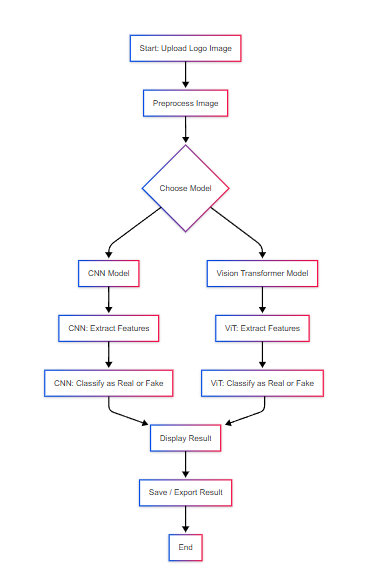
Logo authentication plays a crucial role in combating counterfeiting and preserving brand integrity. This project focuses on classifying real and fake logos using advanced deep learning techniques. A custom image dataset consisting of real and counterfeit logos is used to train and evaluate classification models. Two state-of-the-art approaches are employed: Convolutional Neural Networks (CNNs), known for their efficiency in extracting spatial features from images, and Vision Transformers (ViTs), which leverage self-attention mechanisms for capturing long-range dependencies in visual data. The CNN model focuses on localized patterns and textures to distinguish genuine logos, while the ViT model learns global image representations for robust classification. By comparing the performance of both models in terms of accuracy, precision, and computational efficiency, the study aims to identify the most effective approach for logo verification. The proposed system can be integrated into digital platforms to automatically detect counterfeit logos, supporting brand protection and enhancing consumer trust.
Keywords:
Fake Logo Detection, Real Logo Classification, Convolutional Neural Networks
(CNN), Vision Transformers (ViT).
NOTE: Without the concern of our team, please don't submit to the college. This Abstract varies based on student requirements.
Block Diagram
Specifications
SOFTWARE FRONT END REQUIREMENTS
H/W CONFIGURATION:
- Processor: Intel Core i3 or higher / AMD equivalent
- RAM: Minimum 4 GB (Recommended: 8 GB or more)
- Storage: 250 GB or more available space
- GPU: CUDA-enabled NVIDIA GPU (Recommended for faster training)
- Network: Required for dataset access, model updates, and cloud deployment
- Display: 1024x768 resolution or higher
S/W CONFIGURATION:
- Operating System: Windows 10 / Ubuntu Linux / macOS
- Programming Language: Python 3.8+
- Frameworks: PyTorch, Torchvision
- Visualization: Matplotlib, Seaborn
- Dataset Handling: Pandas, NumPy, PIL
- Development Tools: Jupyter Notebook / VS Code
- Deployment (optional): Flask / FastAPI for API endpoints
- Version Control: Git

Demo Video


Request for Video
Related Projects
 Paper Publishing
Request Call Back
Would you like to receive a free callback now?
Choose the best time for callback:
Leave your message and we will contact you as soon as possible

6-2-85/B, Old Maternity Hospital Road, Thyagaraja Nagar, Tirupati, Andhra Pradesh – 517501
+91 9030333433
+91 9393939065
0877-2261612

Disclaimer - Takeoff Edu Group Projects are not associated or affiliated with IEEE in any way. The IEEE Projects mentioned here are mentioned in the context of student projects, whose ideas are derived from IEEE publications, not projects of or by IEEE.

