Extraction of Ayurvedic Documents Using Deep Learning Algorithms
Objective
The main objective of this project is classification and properties of Ayurveda herbs using Deep learning algorithms.
Abstract
ABSTRCT: Ayurveda, Yoga, Unani, Siddha, and Homeopathy are some of India's traditional medicinal systems. Ayurveda is effective in healing ailments without causing adverse effects. Medicinal plants or herbs are regarded as a valuable resource for satisfying people's health-care needs. It is necessary to preserve and digitise information regarding this therapeutic knowledge. In the form of unstructured textual data, there have been a huge number of publications and articles on Ayurveda research. Text mining is utilised to provide a solution for dealing with such large amounts of unstructured data. With the exponential growth of text-based data, finding the necessary information has become a difficult challenge. The ability to understand the semantics of document content is essential for assuring the quality of content retrieval. However, current approaches are discovering variations in textual categorization in order to improve classification accuracy, which may result in a failure to comprehend data during classification. As a result, an effective model for searching, classifying, and retrieving the most relevant data is necessary. The major goal of this study is to provide an effective and efficient framework and algorithm for searching for and retrieving the most relevant information using an ontology-based text mining approach. To investigate the challenges of locating useful information in the Ayurveda medical system, as well as the changes and opportunities that information technology provides to various aspects of traditional Indian medicine Ontologies and semantic tools are described in order to gain deep knowledge from data. In addition, we modified an ontology-based model that aids in the rapid discovery of semantic information. This model demonstrates that it is appropriate for locating useful data while maintaining the system's efficiency and performance.
The information extraction methodology is implemented using a medicinal plant ontology with semantic knowledge representation and an algorithm called OCEC (Ontology based Concept Extraction and Classification), in which each term is semantically described by mapping the terms and their related terms in the medicinal plant ontology.
Keywords: Ayurveda Herbs Images and details, Deep Learning, CNN, Densent121, Resnet50.
NOTE: Without the concern of our team, please don't submit to the college. This Abstract varies based on student requirements.
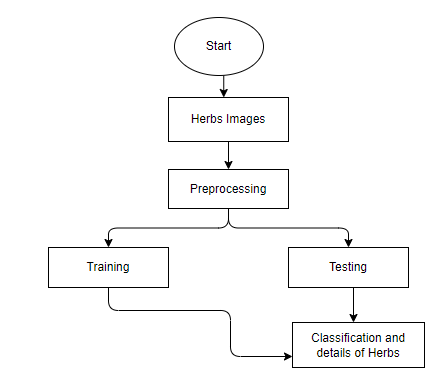
Block Diagram
Specifications
H/W Specifications:
· Processor : I5/Intel Processor
· RAM : 8GB (min)
· Hard Disk : 128 GB
S/W Specifications:
• Operating System : Windows 10
• Server-side Script : Python 3.6
• IDE : PyCharm,Jupyter notebook
• Libraries Used : Numpy, IO, OS, Flask, keras, pandas, tensorflow
Learning Outcomes
· Practical exposure to
· Hardware and software tools
· Solution providing for real time problems
· Working with team/individual
· Work on creative ideas
· Testing techniques
· Error correction mechanisms
· What type of technology versions is used?
· Working of Tensor Flow
· Implementation of Deep Learning techniques
· Working of CNN algorithm
· Working of Transfer Learning methods
· Building of model creations
· Scope of project
· Applications of the project
· About Python language
· About Deep Learning Frameworks
· Use of Data Science


Related Projects
 Paper Publishing

Request Call Back
Would you like to receive a free callback now?
Choose the best time for callback:
Leave your message and we will contact you as soon as possible

6-2-85/B, Old Maternity Hospital Road, Thyagaraja Nagar, Tirupati, Andhra Pradesh – 517501
+91 9030333433
+91 9393939065
0877-2261612

Disclaimer - Takeoff Edu Group Projects are not associated or affiliated with IEEE in any way. The IEEE Projects mentioned here are mentioned in the context of student projects, whose ideas are derived from IEEE publications, not projects of or by IEEE.

