Exploring the Effectiveness of Machine Learning and Deep Learning Techniques for EEG Signal Classification in Neurological Disorders
Objective
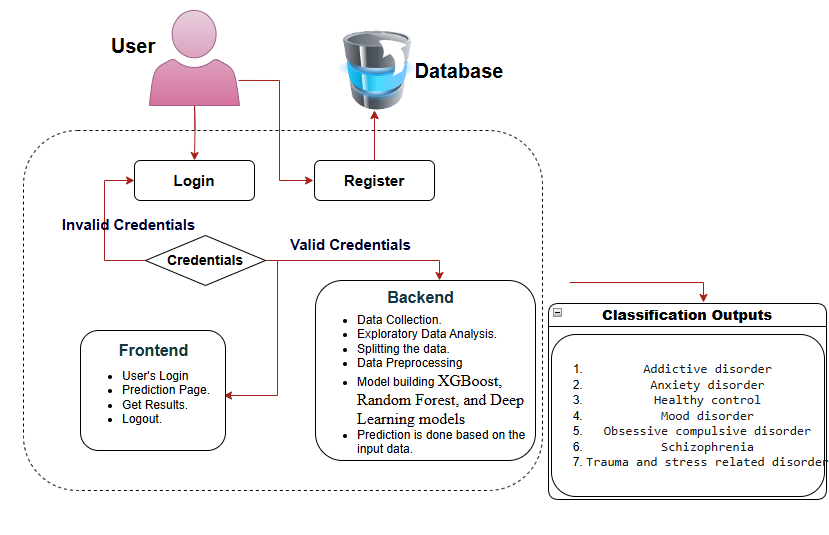
The objective of this project is to enhance the accuracy of EEG signal classification for diagnosing neurological disorders, including addictive disorders, anxiety disorders, mood disorders, obsessive-compulsive disorder (OCD), schizophrenia, and trauma-related stress disorders. The project aims to leverage advanced machine learning and deep learning models such as XGBoost, Random Forest, and Deep Learning techniques to improve the reliability of EEG signal classification. By categorizing EEG signals into the distinct classes mentioned above, the goal is to provide healthcare professionals with more accurate, early diagnosis tools, ultimately aiding in better treatment and care management for patients with neurological conditions.
Abstract
EEG signal classification is an important area of research for diagnosing and understanding various neurological disorders. As the prevalence of disorders such as anxiety, mood disorders, obsessive-compulsive disorder (OCD), schizophrenia, and trauma-related stress increases, the ability to accurately classify EEG signals becomes essential for early detection and effective treatment. This study focuses on the use of machine learning and deep learning techniques to classify EEG signals into distinct categories: Addictive disorder, Anxiety disorder, Healthy control, Mood disorder, Obsessive-compulsive disorder, Schizophrenia, and Trauma and stress-related disorder.
We investigate the application of advanced algorithms such as XGBoost, Random Forest, and Deep Learning models, specifically designed to analyze and identify patterns in EEG signals. These techniques aim to distinguish between the various conditions and provide insights into the underlying neural mechanisms. Through this research, we assess the effectiveness of each model in terms of accuracy, precision, recall, and robustness for neurological disorder classification.
The results of this study underscore the potential of machine learning and deep learning methods in providing accurate and timely classification of EEG signals, ultimately supporting healthcare professionals in diagnosing neurological disorders more effectively. This research contributes to the advancement of AI-powered medical diagnostics, with the potential to revolutionize how neurological conditions are diagnosed and treated.
Keywords: EEG Signal Classification, XGBoost, Random Forest, Deep Learning, Machine Learning, Neurological Disorders, Anxiety, Mood Disorders, Obsessive-Compulsive Disorder, Schizophrenia, Trauma-Related Disorders, AI in Healthcare Diagnostics.
NOTE: Without the concern of our team, please don't submit to the college. This Abstract varies based on student requirements.
Block Diagram
Specifications
SOFTWARE REQUIREMENS
Operating System : Windows 7/8/10
Server side Script : HTML, CSS, Bootstrap & JS
Programming Language : Python
Libraries Django, Pandas, Torch, Keras, Sklearn, Numpy , Seaborn
IDE/Workbench : VSCode
Server Deployment : Xampp Server
Database : SQLite
HARDWARE REQUIREMENTS
Processor - I3/Intel Processor
RAM - 8GB (min)
Hard Disk - 128 GB
Key Board - Standard Windows Keyboard
Mouse - Two or Three Button Mouse
Monitor - Any


Related Projects
 Paper Publishing

Request Call Back
Would you like to receive a free callback now?
Choose the best time for callback:
Leave your message and we will contact you as soon as possible

6-2-85/B, Old Maternity Hospital Road, Thyagaraja Nagar, Tirupati, Andhra Pradesh – 517501
+91 9030333433
+91 9393939065
0877-2261612

Disclaimer - Takeoff Edu Group Projects are not associated or affiliated with IEEE in any way. The IEEE Projects mentioned here are mentioned in the context of student projects, whose ideas are derived from IEEE publications, not projects of or by IEEE.

