Explainable Data Driven Digital Twins for Predicting Battery States in Electric Vehicles
Objective
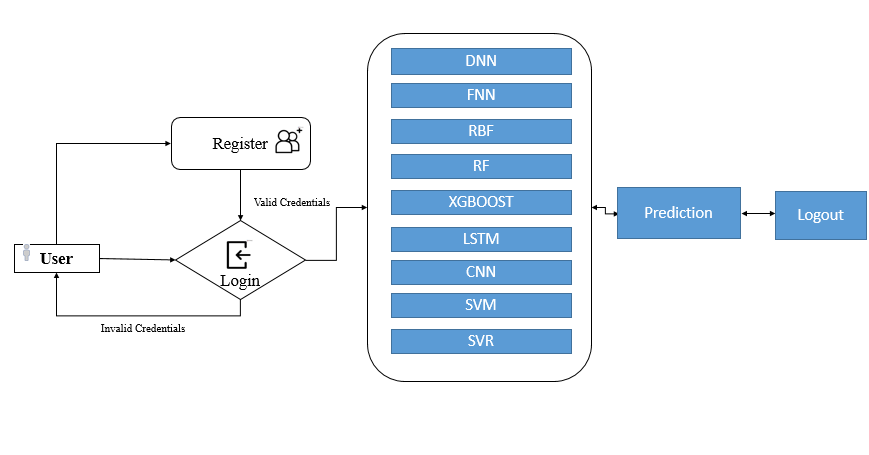
This work aims to develop an advanced Digital Twin model for predicting battery states (SOC and SOH) in electric vehicles, using algorithms like DNN, LSTM, CNN, SVR, Random Forests, and XGBoost. The goal is to enhance model accuracy, interpretability through explainable AI, and compare its performance with conventional methods, providing a smarter, more transparent solution for battery management and durability assessment in the EV industry.
Abstract
Abstract
The main goal of this work is to predict medication toxicity with the help of deep learning models and consider opioids prescriptions only. As the dataset used has 25k records and 256 features, Recurrent Neural Networks (RNN), Random Forest, XGBoost, Voting Classifier increase the chances of prediction. To enhance the feature space in the dataset, various features regarding medications that are frequently prescribed include ACETAMINOPHEN, GABAPENTIN, and LEVOTHYROXINE among others; the target feature is known as the ‘Opioid Prescriber’. With the goal of detecting whether a prescriber is subscribing opioids and to minimize the threats related tole opioid toxicity, this work tries to ascertain associative structures among distinct medications. The integration of machine learning and deep learning will form a strong foundation, so further enhancing prescription safety and eliminating opioid toxicities.
Keywords: Medication Toxicity Forecasting: Deep Learning for the Prediction of Opioid Prescriber Random Forest, eXtreme Gradient Boosting, Voting Classifier Prescription Pattern Analysis: Toxicity Levels of Medication Ensemble Learning
NOTE: Without the concern of our team, please don't submit to the college. This Abstract varies based on student requirements.
Block Diagram
Specifications
SOFTWARE AND HARDWARE REQUIREMENTS:
Hardware:
Operating system : Windows 7 or 7+
RAM : 8 GB
Hard disc or SSD : More than 500 GB
Processor : Intel 3rd generation or high or Ryzen with 8 GB Ram
Software:
Software’s : Python 3.10 or high version
IDE : Visual Studio Code.
Framework : Flask


Related Projects
 Paper Publishing

Request Call Back
Would you like to receive a free callback now?
Choose the best time for callback:
Leave your message and we will contact you as soon as possible

6-2-85/B, Old Maternity Hospital Road, Thyagaraja Nagar, Tirupati, Andhra Pradesh – 517501
+91 9030333433
+91 9393939065
0877-2261612

Disclaimer - Takeoff Edu Group Projects are not associated or affiliated with IEEE in any way. The IEEE Projects mentioned here are mentioned in the context of student projects, whose ideas are derived from IEEE publications, not projects of or by IEEE.

