Evaluation of MLDL algorithms in detecting DDOS attacks for subset features in SDN environment
Objective
The objective of this project is to develop a machine learning and deep learning (MLDL) framework for detecting and classifying Distributed Denial of Service (DDoS) attacks in Software-Defined Networking (SDN). Using a combination of models like Random Forest, Decision Tree, SVM, and XGBoost, the system classifies network traffic as benign or DDoS-affected. The project focuses on optimizing these models to improve detection accuracy and minimize false positives, while incorporating SHAP for better model interpretability. The goal is to create a scalable, efficient, and interpretable solution for real-time DDoS detection in SDN environments.
Abstract
The growing complexity and scale of modern network infrastructures have made them more vulnerable to Distributed Denial of Service (DDoS) attacks, posing significant risks to service availability. Software-Defined Networking (SDN) has emerged as a promising architecture to enhance network management and security. This research focuses on evaluating various machine learning and deep learning (MLDL) algorithms for detecting DDoS attacks in an SDN environment using a subset of network traffic features. The proposed approach includes a hybrid model combining Random Forest (RF) and Decision Tree (DT), along with individual models such as Support Vector Machine (SVM) and XGBoost. These models aim to classify network traffic into benign and DDoS-affected categories based on feature subsets like packet flow, traffic patterns, and anomaly indicators. The performance of each model is assessed in terms of accuracy, precision, recall, and F1-score, with the goal of identifying the most effective algorithm for real-time detection of DDoS attacks in SDN-based networks. The results demonstrate that the hybrid RF-DT model outperforms the other algorithms, offering a robust solution for mitigating DDoS threats in SDN environments. This study provides valuable insights into the integration of MLDL techniques for improving network security and resilience against evolving cyber threats.
Keywords: DDoS attacks, Software-Defined Networking (SDN), Machine Learning, Deep Learning, Hybrid Model, Random Forest, Decision Tree, Support Vector Machine (SVM), XGBoost, Network Traffic, Anomaly Detection, Classification, Cybersecurity, Network Security.
NOTE: Without the concern of our team, please don't submit to the college. This Abstract varies based on student requirements.
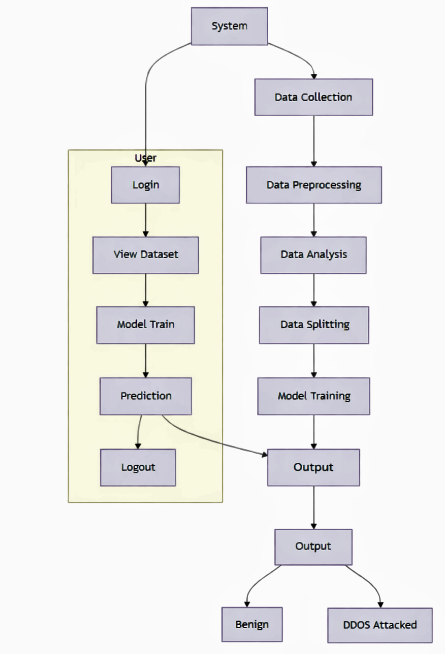
Block Diagram
Specifications
3.1 SOFTWARE REQUIREMENS
Operating System : Windows 7/8/10
Server side Script : HTML, CSS, Bootstrap & JS
Programming Language : Python
Libraries : Django,Torch, Keras, Pandas,Json, , Numpy , Seaborn
IDE/Workbench : VSCode
Server Deployment : Xampp Server
Database : SQLite
3.2 HARDWARE REQUIREMENTS
Processor - I3/Intel Processor
RAM - 8GB (min)
Hard Disk - 128 GB
Key Board - Standard Windows Keyboard
Mouse - Two or Three Button Mouse
Monitor - Any


Related Projects
 Paper Publishing

Request Call Back
Would you like to receive a free callback now?
Choose the best time for callback:
Leave your message and we will contact you as soon as possible

6-2-85/B, Old Maternity Hospital Road, Thyagaraja Nagar, Tirupati, Andhra Pradesh – 517501
+91 9030333433
+91 9393939065
0877-2261612

Disclaimer - Takeoff Edu Group Projects are not associated or affiliated with IEEE in any way. The IEEE Projects mentioned here are mentioned in the context of student projects, whose ideas are derived from IEEE publications, not projects of or by IEEE.

