Ethical Hacking importance of Information Technology
Objective
The primary objective of this research is to ascertain individuals' willingness to pursue ethical hacking certification by analyzing demographic and attitudinal factors such as age, gender, education level, employment status, years of IT experience, and familiarity with ethical hacking. Additionally, the study aims to uncover motivations and barriers associated with ethical hacking certification, predict individuals' readiness to pursue certification using machine learning classifiers, and provide insights for enhancing cybersecurity preparedness and fostering a skilled cybersecurity workforce in IT-related fields.
Abstract
This research delves into the significance of ethical hacking in the realm of information technology (IT) by examining various factors like age, gender, education level, employment status, years of IT experience, and familiarity with ethical hacking. Through the use of machine learning classifiers such as MLP, Linear Discriminant Analysis, and K-Nearest Neighbors, the study aims to ascertain individuals' willingness to pursue ethical hacking certification. Ethical hacking holds pivotal importance in contemporary cybersecurity strategies, especially in IT-related fields. Recognizing the importance of ethical hacking knowledge and its impact on job roles, encountered security breaches, awareness of cybersecurity, legal implications, company investment in security measures, salary effects, societal perceptions, and engagement in ethical hacking communities is crucial. By analyzing these factors, the research endeavors to uncover the motivations and inclinations of individuals towards obtaining ethical hacking certification. Through the application of machine learning classifiers, the study seeks to uncover underlying patterns and relationships within the dataset to predict individuals' readiness to pursue ethical hacking certification. Ultimately, this study advances our comprehension of the role of ethical hacking in IT and cybersecurity domains, providing valuable insights for professionals, organizations, and educational institutions striving to foster cybersecurity expertise while ensuring originality and avoiding plagiarism.
Keywords: Information technology, MLP, Linear Discriminant Analysis, and K-Nearest Neighbours.
NOTE: Without the concern of our team, please don't submit to the college. This Abstract varies based on student requirements.
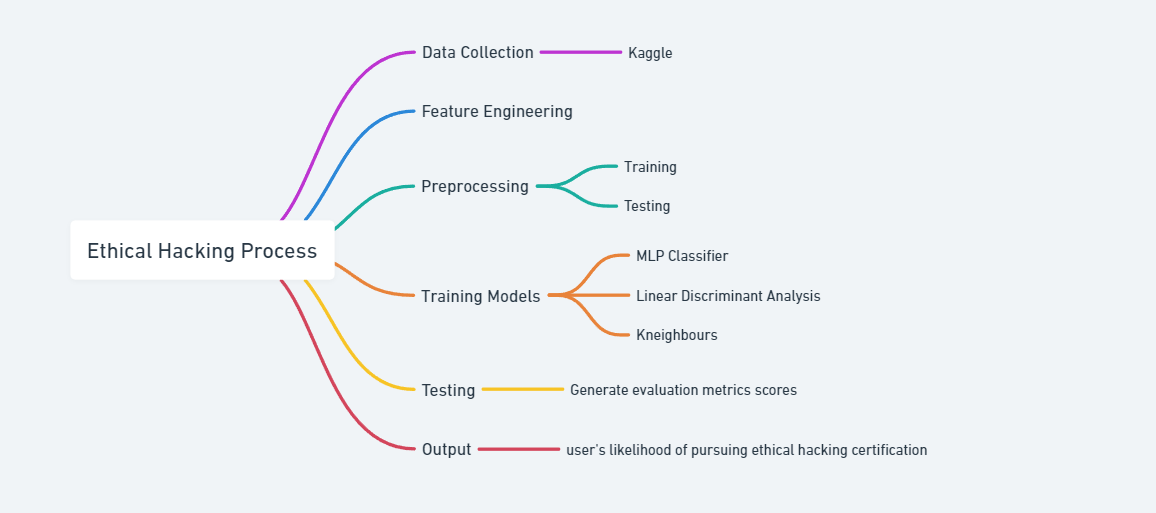
Block Diagram
Specifications
Hardware:
Operating system : Windows 7 or 7+
RAM : 8 GB
Hard disc or SSD : More than 500 GB
Processor : Intel 3rd generation or high or Ryzen with 8 GB Ram
Software:
Software’s : Python 3.6 or high version
IDE : VSCode.
Framework : Flask


Related Projects
 Paper Publishing

Request Call Back
Would you like to receive a free callback now?
Choose the best time for callback:
Leave your message and we will contact you as soon as possible

6-2-85/B, Old Maternity Hospital Road, Thyagaraja Nagar, Tirupati, Andhra Pradesh – 517501
+91 9030333433
+91 9393939065
0877-2261612

Disclaimer - Takeoff Edu Group Projects are not associated or affiliated with IEEE in any way. The IEEE Projects mentioned here are mentioned in the context of student projects, whose ideas are derived from IEEE publications, not projects of or by IEEE.

