Enhancing Detection of Misleading Visualizations Using DeepSeek Models
Objective
This project focuses on fine-tuning and evaluating deep learning models like GPT-2, XLNet, and RoBERTa to classify real and fake tweets, emphasizing detection of deceptive visuals and AI-generated content. It integrates multimodal data—combining text and images—to improve fake tweet detection. The study compares model performances using accuracy, precision, recall, and F1-score to identify strengths and weaknesses. Finally, it aims to develop a user-friendly system that allows users to input tweets for real-time authenticity checks, making the research practical and helping to combat misinformation on social media platforms.
Abstract
The emergence of social media networks has increased
the challenges in telling the real and fake information. False information and
deceptive visualization can go viral and impact on the masses, and even lead to
social damage. This paper presents a solution to improve the techniques of fake
twitter and especially those ones that present a false image or a message. The
aim is to calibrate and compare the results of different state-of-the-art deep
learning nature in detecting fake news, among which are GPT-2, DeepSeek-R1,
DeepSeek-V3, XLNet, and RoBERTa.
Keywords: GPT-2, DeepSeek-R1, DeepSeek-V3, XLNet, RoBERTa, LLM, Deep Learming.
NOTE: Without the concern of our team, please don't submit to the college. This Abstract varies based on student requirements.
Block Diagram
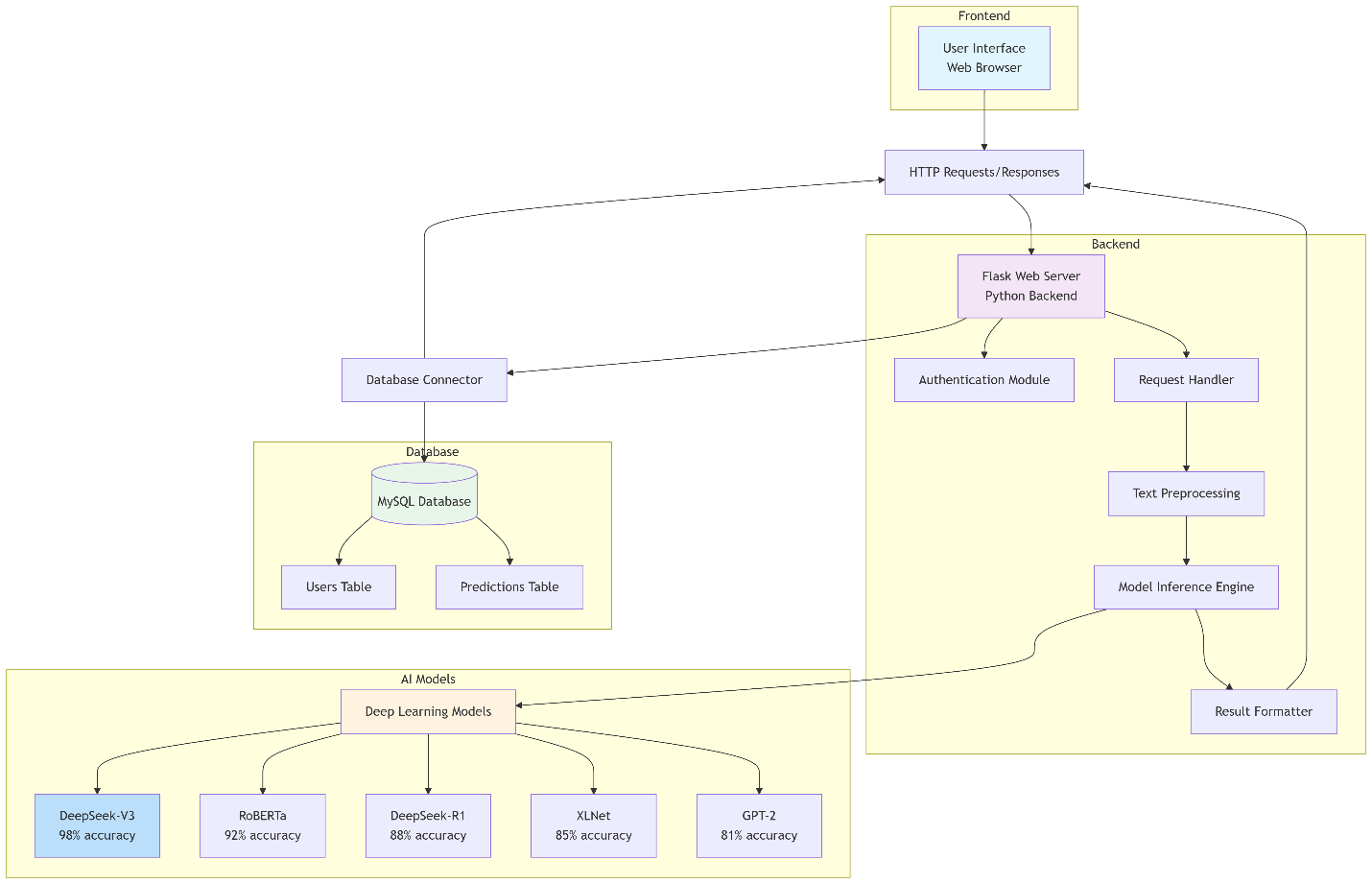
Specifications
SOFTWARE REQUIREMENS
Operating System : Windows 7/8/10
Server side Script : HTML, CSS, Bootstrap & JS
Programming Language : Python
Libraries Flask, Pandas, Torch, Sklearn, Librosa, Numpy , Seaborn, Matplotlib
IDE/Workbench : VSCode
Server Deployment : Xampp Server
Database : MySQL
HARDWARE REQUIREMENTS
Processor - I3/Intel Processor
RAM - 8GB (min)
Hard Disk - 128 GB
Key Board - Standard Windows Keyboard
Mouse - Two or Three Button Mouse
Monitor - Any


Related Projects
 Paper Publishing

Request Call Back
Would you like to receive a free callback now?
Choose the best time for callback:
Leave your message and we will contact you as soon as possible

6-2-85/B, Old Maternity Hospital Road, Thyagaraja Nagar, Tirupati, Andhra Pradesh – 517501
+91 9030333433
+91 9393939065
0877-2261612

Disclaimer - Takeoff Edu Group Projects are not associated or affiliated with IEEE in any way. The IEEE Projects mentioned here are mentioned in the context of student projects, whose ideas are derived from IEEE publications, not projects of or by IEEE.

