Enhanced Test Pattern Generator using Modified LFSR
Objective
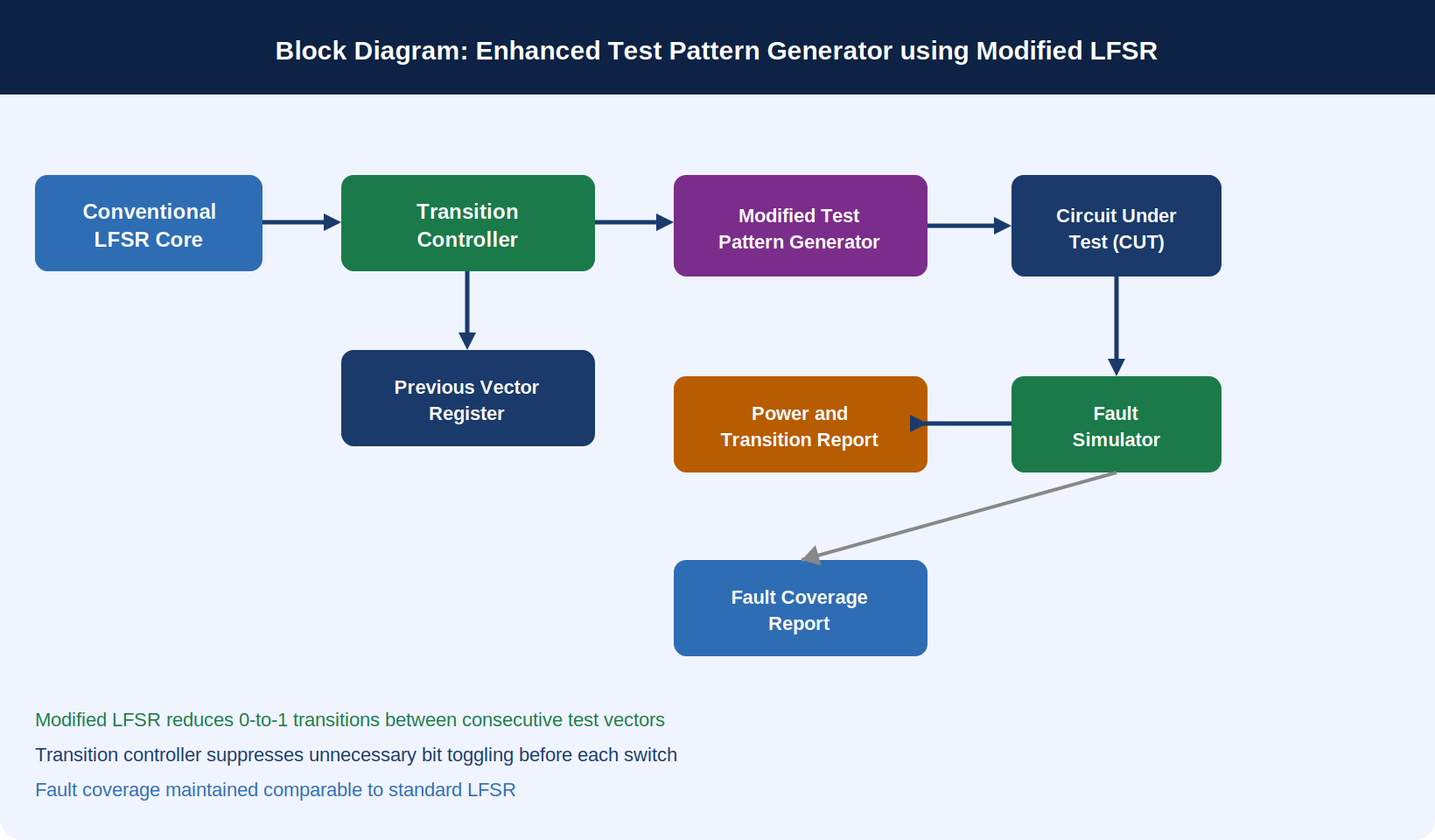
Built-In Self Test (BIST) is a widely adopted Design-for-Testability strategy that embeds test logic within integrated circuits for autonomous fault detection. Among various pattern generation techniques, Linear Feedback Shift Registers (LFSRs) are favored for their simplicity and low area overhead. However, conventional LFSRs generate pseudorandom patterns with high switching activity between successive test vectors, causing excessive dynamic power consumption during testing. This paper proposes an enhanced Test Pattern Generator (TPG) using a structurally modified LFSR incorporating a transition control mechanism to improve inter-vector correlation.
Abstract
Built-In Self Test (BIST) is a widely adopted Design-for-Testability strategy that embeds test logic within integrated circuits for autonomous fault detection. Among various pattern generation techniques, Linear Feedback Shift Registers (LFSRs) are favored for their simplicity and low area overhead. However, conventional LFSRs generate pseudorandom patterns with high switching activity between successive test vectors, causing excessive dynamic power consumption during testing. This paper proposes an enhanced Test Pattern Generator (TPG) using a structurally modified LFSR incorporating a transition control mechanism to improve inter-vector correlation. The modification significantly reduces bit transitions between consecutive patterns, lowering switching activity and dynamic power. Results on ISCAS benchmark circuits demonstrate notable power reduction while maintaining comparable fault coverage, making the design suitable for low-power BIST applications in VLSI circuits.
Keywords: Test Pattern Generator, LFSR, BIST, Low Power Testing, Switching Activity, Fault Coverage, DFT, VLSI
NOTE: Without the concern of our team, please don't submit to the college. This Abstract varies based on student requirements.
Block Diagram
Specifications
Software Requirements
• Xilinx Vivado / ISE
• Verilog HDL / ModelSim
Hardware Requirements
• Xilinx FPGA (Spartan / Virtex)
• Logic Analyzer
Learning Outcomes
• LFSR Design and Optimization
• BIST Architecture Implementation
• Low Power Test Methodology
• Fault Coverage Analysis
• DFT Techniques in VLSI


Related Projects
 Paper Publishing

Request Call Back
Would you like to receive a free callback now?
Choose the best time for callback:
Leave your message and we will contact you as soon as possible

6-2-85/B, Old Maternity Hospital Road, Thyagaraja Nagar, Tirupati, Andhra Pradesh – 517501
+91 9030333433
+91 9393939065
0877-2261612

Disclaimer - Takeoff Edu Group Projects are not associated or affiliated with IEEE in any way. The IEEE Projects mentioned here are mentioned in the context of student projects, whose ideas are derived from IEEE publications, not projects of or by IEEE.

