Energy Efficient High Performance 64bit ALU using Reversible Logic Based on Self Error Detection and Correction Technique
Objective
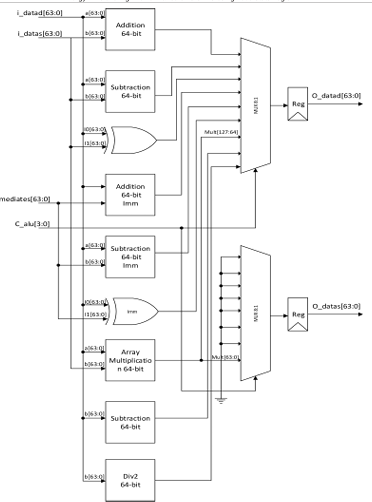
The aim of this research proposal is to design 64-Bit a self-error detection–based arithmetic operations unit, which is widely required in today’s AI technology for performing high-speed calculations of arithmetic and logical operations, and is a top priority in deep learning algorithms. In the proposed method, a high-speed and double precision arithmetic and logic unit (ALU) is designed, which employs reversible majority gate technology along with parity checking and error-correcting codes (ECC) to improve fault tolerance for low-power computing systems
Abstract
The aim of this research proposal is to design 64-Bit a self-error detection–based arithmetic operations unit, which is widely required in today’s AI technology for performing high-speed calculations of arithmetic and logical operations, and is a top priority in deep learning algorithms. In the proposed method, a high-speed and double precision arithmetic and logic unit (ALU) is designed, which employs reversible majority gate technology along with parity checking and error-correcting codes (ECC) to improve fault tolerance for low-power computing systems. Reversible logic gates are given high priority in larger circuit designs and the use of more FPGA resources, as they reduce garbage signals and critical path delay in combinational design architecture. This reversible logic reduces the signal path and increases energy efficiency. Furthermore, to simplify complex logic operations, the novelty architecture designed a full adder using the majority logic (ML) gate, which uses reversible methodology that is specially used for Feynman and Toffoli gates. For self-error correction, parity checking is utilized to identify single-bit mistakes, whereas Hamming code–based error correction was also included for multibit mistakes, and these hybrid implementations are helpful to detect and rectify errors.
Keywords—Verilog HDL, Arithmetic operations, error-correcting codes, Xilinx vivadoNOTE: Without the concern of our team, please don't submit to the college. This Abstract varies based on student requirements.
Block Diagram
Specifications
Learning Outcomes
· Verilog HDL concepts.
1. Behavioural modelling.
2. Always block.
3. Case statements.
4. Casex statements.
5. Data-flow modelling.
6. Assign statements.
7. FSM concepts.
Simple digital electronics concepts


Related Projects
 Paper Publishing

Request Call Back
Would you like to receive a free callback now?
Choose the best time for callback:
Leave your message and we will contact you as soon as possible

6-2-85/B, Old Maternity Hospital Road, Thyagaraja Nagar, Tirupati, Andhra Pradesh – 517501
+91 9030333433
+91 9393939065
0877-2261612

Disclaimer - Takeoff Edu Group Projects are not associated or affiliated with IEEE in any way. The IEEE Projects mentioned here are mentioned in the context of student projects, whose ideas are derived from IEEE publications, not projects of or by IEEE.

