Energy Efficient Design and Implementation of Approximate Adder for Image Processing Applications
Objective
The objective of this project is to design and implement an energy-efficient approximate adder that reduces power consumption and area for image processing applications while maintaining acceptable computational accuracy. It aims to optimize the trade-off between energy efficiency and result precision for high-performance low-power VLSI systems.
Abstract
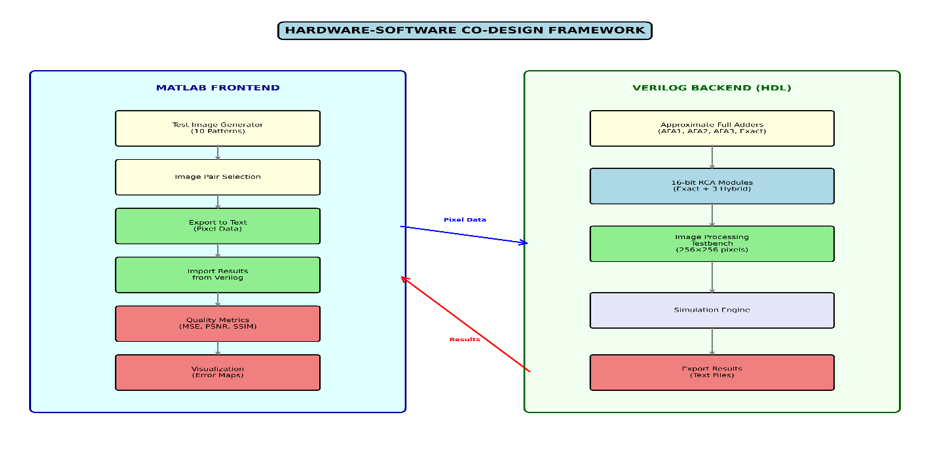
This project presents a comprehensive hardware-software co-design implementation of approximate computing techniques for energy-efficient image processing, featuring three distinct approximate full adder (AFA) designs—AFA1, AFA2, and AFA3—implemented in Verilog HDL and integrated with MATLAB-based image processing workflows. The system employs a hybrid 16-bit ripple carry adder architecture that strategically uses approximate adders for the 8 least significant bits while maintaining exact computation for the 8 most significant bits, achieving a balance between computational accuracy and hardware efficiency. Complete implementations include Verilog modules with comprehensive testbenches, automated MATLAB scripts for test image generation (10 distinct patterns), batch processing capabilities, and quality metric computation (MSE, PSNR, SSIM) with organized result visualization. Experimental results demonstrate that all three approximate adders achieve acceptable image quality (PSNR > 30 dB) while providing substantial hardware benefits: AFA1 delivers 28% LUT reduction with 34.1% zero-error rate on MSB operations, AFA2 achieves 41% LUT reduction with 24% power savings, and AFA3 offers maximum hardware simplification with 45% LUT reduction and 30% power savings. The complete framework validates approximate computing as a viable approach for error-tolerant applications, demonstrating that strategic approximation in non-critical bit positions yields significant energy and area savings without perceptible quality degradation, with applications in image processing, digital signal processing, multimedia systems, IoT devices, and mobile computing where energy efficiency is paramount.
Keywords: Approximate Computing, Approximate Adders, Image Processing, Energy Efficiency, Hardware-Software Co-Design, FPGA, Error-Tolerant Computing, Verilog, MATLAB, PSNR, MSE, SSIM
NOTE: Without the concern of our team, please don't submit to the college. This Abstract varies based on student requirements.
Block Diagram
Specifications
xilinx vivado and matlab
Learning Outcomes
Understand the concept of approximate computing and its trade-offs between accuracy and energy efficiency.
Learn how to design low-power approximate adders for image processing applications.
Analyze the impact of approximation on image quality and system performance.
Gain hands-on experience in CMOS implementation and circuit simulation.
Develop skills in power, delay, and area optimization for low-power VLSI designs.
Understand practical applications of approximate arithmetic in real-time multimedia and embedded systems.
Demo Video


Request for Video
Related Projects
 Paper Publishing
Request Call Back
Would you like to receive a free callback now?
Choose the best time for callback:
Leave your message and we will contact you as soon as possible

6-2-85/B, Old Maternity Hospital Road, Thyagaraja Nagar, Tirupati, Andhra Pradesh – 517501
+91 9030333433
+91 9393939065
0877-2261612

Disclaimer - Takeoff Edu Group Projects are not associated or affiliated with IEEE in any way. The IEEE Projects mentioned here are mentioned in the context of student projects, whose ideas are derived from IEEE publications, not projects of or by IEEE.

