Emotion Based Safe Driving
Objective
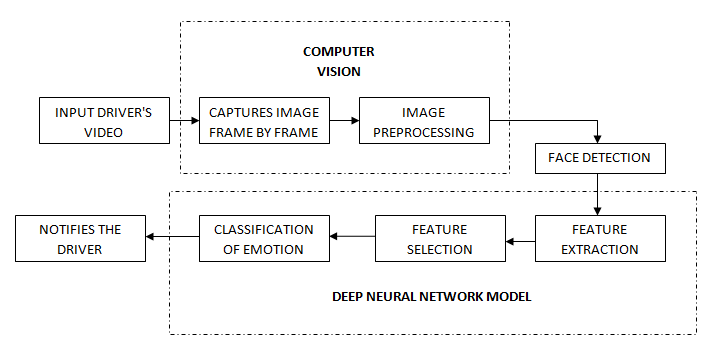
Studies have established that driver’s emotions plays an important role in driving behavior. Therefore, continuous monitoring of the driver’s emotions and requisite warning to the driver will help in maintaining safety on the roads. In this application, we propose a real time camera based emotion detection system using deep learning and AI to alert the driver.
Abstract
While driving in a car, the driver can be affected by various emotionally challenging situations. They can either be triggered by the current driving situation, e.g. being cut off by another driver, or caused by a personal event, e.g. receiving good news. On the one hand, emotions can affect the driving behavior in positive and negative ways.
By sensing fear, the driver is able to perceive a situation as a possible risk and adapt his driving towards the situation, while anger may lead to an underestimation of the risk level and therefore may increase the risk of causing an accident. In this application, we propose a framework for driver’s emotion recognition using facial expression recognition.
We assume that a camera is optimally placed inside a vehicle, constantly looking at the driver’s face. Our framework comprises of extracting features from real-time video input using deep learning and classifying the emotion using Grassmann manifold based learning.
Keywords: Driver Emotion Recognition, Facial Expression Recognition, Intelligent Vehicles, Grassmann Manifolds, Machine Learning, Computer Vision.
NOTE: Without the concern of our team, please don't submit to the college. This Abstract varies based on student requirements.
Block Diagram
Specifications
H/W SPECIFICATIONS:
- Processor: I3/Intel
- Processor RAM: 4GB (min)
- Hard Disk: 128 GB
- Key Board: Standard Windows Keyboard
- Mouse: Two or Three Button Mouse
- Monitor: Any
S/W SPECIFICATIONS:
- Operating System: Windows 7+
- Server-side Script: Python 3.6+
- IDE: PyCharm
- Libraries Used: Pandas, Numpy, sklearn, Flask, Seaborn, TensorFlow, OpenCV.
Learning Outcomes
- Importance of Unsupervised Learning.
- Scope of emotion detection of a driver.
- Use of neural networks.
- Importance of PyCharm IDE.
- Working of CNN.
- Understanding Computer vision.
- Implementing Grassmann manifold technique.
- Process of debugging a code.
- The problem with imbalanced dataset.
- Benefits of SMOTE technique.
- Input and Output modules
- How test the project based on user inputs and observe the output
- Project Development Skills:
- Problem analyzing skills.
- Problem solving skills.
- Creativity and imaginary skills.
- Programming skills.
- Deployment.
- Testing skills.
- Debugging skills.
- Project presentation skills.
- Thesis writing skills.


Related Projects
 Paper Publishing

Request Call Back
Would you like to receive a free callback now?
Choose the best time for callback:
Leave your message and we will contact you as soon as possible

6-2-85/B, Old Maternity Hospital Road, Thyagaraja Nagar, Tirupati, Andhra Pradesh – 517501
+91 9030333433
+91 9393939065
0877-2261612

Disclaimer - Takeoff Edu Group Projects are not associated or affiliated with IEEE in any way. The IEEE Projects mentioned here are mentioned in the context of student projects, whose ideas are derived from IEEE publications, not projects of or by IEEE.

