Electricity Load Forecasting Using RNN
Objective
The objective of this project is about load forecasting for an electricity data. Electricity consumption have been increased a lot when compare to the earlier days. Now a day’s humans won’t survive without electricity. If we contribute to prevent the unused electricity, then it should be able to utilize in the areas where the people don’t have abundancy, this study attempts to perform future forecasting on the load, by which we can control abundant electricity. Our model will help to create future predictions which reduce the burden to the people who are continuously working on these electrical companies.
Abstract
Recurrent Neural Network (RNN) based forecasting mechanisms have proved their significance to anticipate in perioperative outcomes to improve the decision making on the future course of actions. The RNN models have long been used in many application domains which needed the identification and prioritization of adverse factors. Several prediction methods are being popularly used to handle forecasting problems. This method demonstrates the capability of RNN model to forecast the electricity load of upcoming days from a city which can be considered to increase or decrease the generation of load. Our proposed method integrates a numeral of approach, intended to advance the cooperativeness of the explore operation. In this work, we develop the project of electricity forecast which can be able to predict outcomes of total load consumed.
KEYWORDS: Electricity, Total load forecast, RNN
NOTE: Without the concern of our team, please don't submit to the college. This Abstract varies based on student requirements.
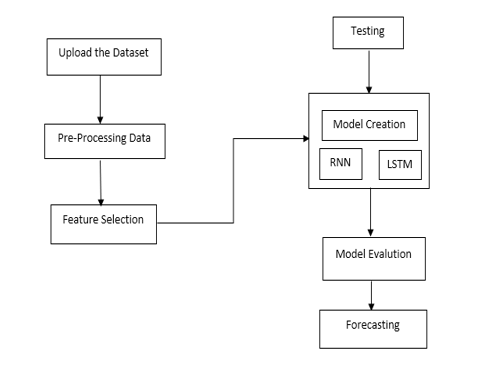
Block Diagram
Specifications
HARDWARE SPECIFICATIONS:
- Processor: I3/Intel
- Processor RAM: 4GB (min)
- Hard Disk: 128 GB
- Key Board: Standard Windows Keyboard
- Mouse: Two or Three Button Mouse
- Monitor: Any
SOFTWARE SPECIFICATIONS:
- Operating System: Windows 7+
- Server-side Script: Python 3.6+
- IDE: Jupyter Notebook
- Libraries Used: Pandas, Numpy.
Learning Outcomes
- Scope of Real Time Application Scenarios
- What type of technology versions are used
- Working Procedure
- Introduction to basic technologies used for
- How project works.
- Input and Output modules
- Frame work use
- Datasets properties
- Deep learning algorithms.
- Data pre-processing techniques
- What is load forecasting’s
- What is multi scaled RNN model
- Project Development Skills:
- Problem analyzing skills.
- Problem solving skills.
- Creativity and imaginary skills.
- Programming skills.
- Deployment.
- Testing skills.
- Debugging skills.
- Project presentation skills.
- Thesis writing skills.
Demo Video


Request for Video
Related Projects
 Paper Publishing
Request Call Back
Would you like to receive a free callback now?
Choose the best time for callback:
Leave your message and we will contact you as soon as possible

6-2-85/B, Old Maternity Hospital Road, Thyagaraja Nagar, Tirupati, Andhra Pradesh – 517501
+91 9030333433
+91 9393939065
0877-2261612

Disclaimer - Takeoff Edu Group Projects are not associated or affiliated with IEEE in any way. The IEEE Projects mentioned here are mentioned in the context of student projects, whose ideas are derived from IEEE publications, not projects of or by IEEE.

