EcoSmart An AIBased Waste Segregation, Recommendation, and Analytics System
Objective
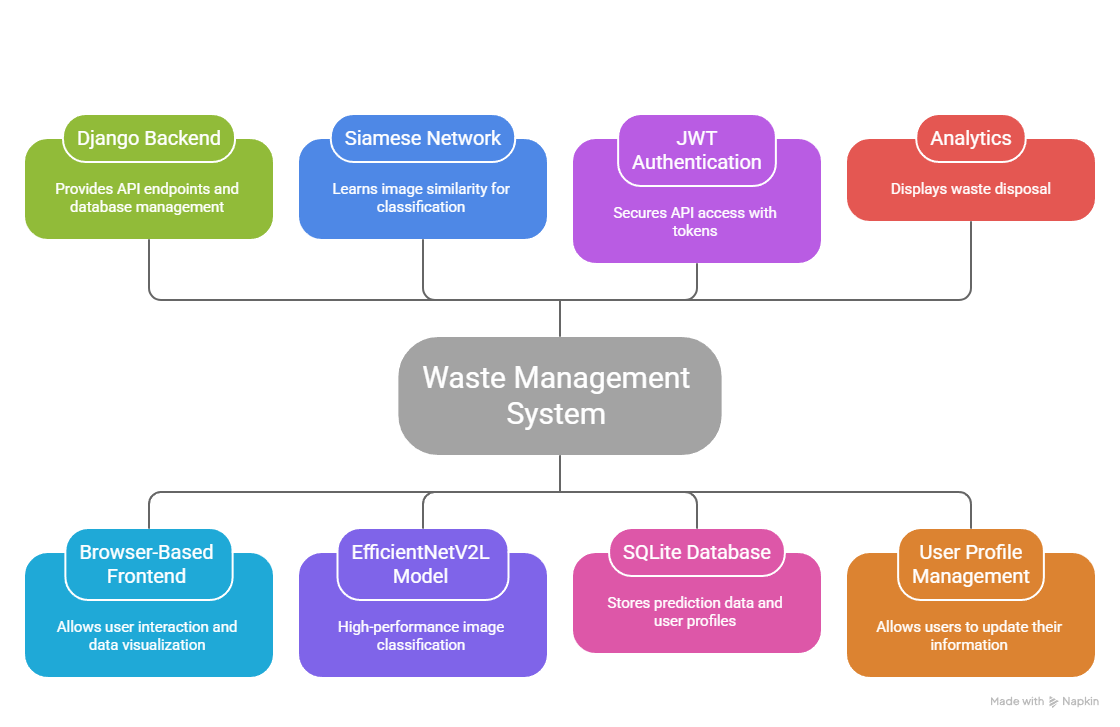
The primary objective of the EcoSmart project is to develop an intelligent waste segregation system using deep learning and web technologies that automatically classifies waste images into hazardous, organic, or recyclable categories, and provides users with immediate disposal guidance (bin colour, bio type, and suggestion). Both models are integrated into a secure Django web application with JWT authentication, allowing users to register, upload waste images, view prediction results, track history, analyse their waste patterns (biodegradable vs non?biodegradable counts, bin usage percentages), and manage profiles.
Abstract
Improper waste disposal poses severe environmental and health risks, calling for automated, accurate sorting systems. This project presents an end‑to‑end web‑based waste classification system that integrates two deep learning approaches: a Siamese neural network trained from scratch to learn similarity embeddings, and a fine‑tuned EfficientNetV2L model equipped with focal loss, RandAugment, and test‑time augmentation (TTA). The Siamese architecture compares image pairs to produce discriminative embeddings; classification is performed by matching a query embedding against class prototypes, achieving 99.9% validation accuracy. The EfficientNetV2L model, trained on the same dataset with two‑stage fine‑tuning and modern regularisation techniques, achieved 80.03% .
Both models are deployed as plug‑in components in a Django web application secured by JWT authentication. Users can register, log in, upload waste images, and receive real‑time predictions of the appropriate bin colour (Green, Blue, Black), bio‑type (Biodegradable or Non‑Biodegradable), and a disposal suggestion (e.g., compost, recycle, hazardous waste facility). All predictions are stored, enabling users to view historical records, per‑class analytics (biodegradable/non‑biodegradable counts, bin usage percentages), and a profile management page. The system also includes a leaderships section and a logout functionality.
Experimental evaluation demonstrates that the Siamese network excels at capturing fine‑grained similarities, while the EfficientNetV2L provides robust performance with advanced augmentation. The integrated web application offers a practical, scalable solution for households, municipalities, and recycling centres, promoting sustainable waste management through artificial intelligence.
Keywords: Waste classification, Siamese network, EfficientNetV2L, focal loss, RandAugment, test‑time augmentation, Django, JWT authentication.
NOTE: Without the concern of our team, please don't submit to the college. This Abstract varies based on student requirements.
Block Diagram
Specifications
4.1 SOFTWARE REQUIREMENS
Operating System : Windows 7/8/10
Server side Script : HTML, CSS, Bootstrap & JS
Programming Language : Python
Libraries Flask, Pandas, Torch, Sklearn, Librosa, Numpy , Seaborn, Matplotlib
IDE/Workbench : VSCode
Server Deployment : Xampp Server
Database : MySQL
4.2 HARDWARE REQUIREMENTS
Processor - I3/Intel Processor
RAM - 8GB (min)
Hard Disk - 128 GB
Key Board - Standard Windows Keyboard
Mouse - Two or Three Button Mouse
Monitor - Any


Related Projects
 Paper Publishing

Request Call Back
Would you like to receive a free callback now?
Choose the best time for callback:
Leave your message and we will contact you as soon as possible

6-2-85/B, Old Maternity Hospital Road, Thyagaraja Nagar, Tirupati, Andhra Pradesh – 517501
+91 9030333433
+91 9393939065
0877-2261612

Disclaimer - Takeoff Edu Group Projects are not associated or affiliated with IEEE in any way. The IEEE Projects mentioned here are mentioned in the context of student projects, whose ideas are derived from IEEE publications, not projects of or by IEEE.

