ECG SIGNAL CLASSIFICATION USING PTBXL DATASET using DL
Objective
The main objective of this project is to develop an automated, accurate, and efficient ECG classification system using deep learning techniques. By leveraging the PTB-XL dataset and combining raw ECG signals with patient metadata, the project aims to classify recordings into key diagnostic categories. The goal is to enhance early detection of cardiac conditions, reduce manual interpretation errors, and support healthcare professionals in making reliable clinical decisions.
Abstract
The increasing prevalence of cardiovascular diseases has necessitated the development of automated diagnostic systems for early detection and accurate classification of heart conditions. Electrocardiography (ECG) is a widely used non-invasive technique for heart health monitoring. However, interpreting ECG signals manually can be time-consuming and error-prone. This project focuses on the classification of ECG signals using deep learning techniques, leveraging the publicly available PTB-XL dataset. The dataset consists of over 21,000 ECG recordings, along with detailed metadata about the patients. In this research, a multi-label classification approach is adopted, where ECG signals are categorized into five diagnostic classes: Normal (NORM), Myocardial Infarction (MI), ST/T Change (STTC), Conduction Disturbance (CD), and Hypertrophy (HYP). The project applies various deep learning models, including Convolutional Neural Networks (CNN), CNN + Long Short-Term Memory (LSTM), CNN + Variational Autoencoder (VAE), and CNN + Bidirectional LSTM with Attention Mechanism, to classify these signals. A combination of metadata and raw ECG data is used to create a comprehensive model for accurate prediction. The final model aims to provide reliable and efficient classifications that can assist healthcare providers in diagnosing cardiac conditions. Evaluation metrics such as binary accuracy, precision, and recall are used to assess the model’s performance. The results show that the CNN + Bidirectional LSTM model achieved the highest classification accuracy, making it a robust solution for ECG signal analysis. This research holds potential for automating cardiac diagnoses, reducing human error, and improving overall healthcare efficiency.
Keywords: ECG classification, deep learning, PTB-XL dataset, CNN, LSTM, VAE, Bidirectional LSTM, cardiac health, Myocardial Infarction, multi-label classification.
NOTE: Without the concern of our team, please don't submit to the college. This Abstract varies based on student requirements.
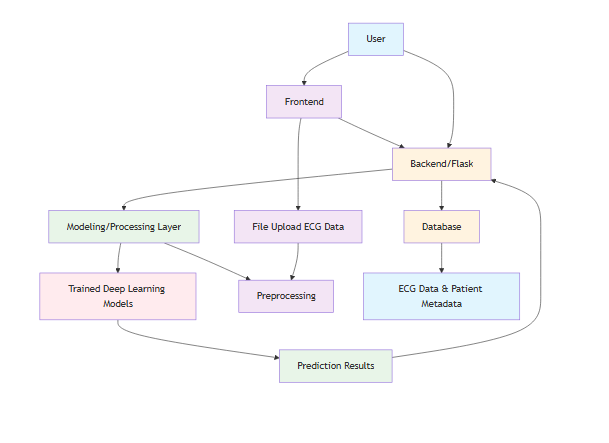
Block Diagram
Specifications
1. SOFTWARE REQUIREMENS
Operating System : Windows 7/8/10
Server-side Script : HTML, CSS, Bootstrap & JS
Programming Language : Python
Libraries : Flask, Pandas,, Sklearn, NumPy, Seaborn, Matplotlib,pytorch
IDE/Workbench : VSCode
Technology : Python 3.8+
Server Deployment : Xampp Server
Database : MySQL
2. HARDWARE REQUIREMENTS
Processor - I5/Intel Processor
RAM - 8GB+ (min)
Hard Disk - 128 GB+
Key Board - Standard Windows Keyboard
Mouse - Two or Three Button Mouse
Monitor - Any


Related Projects
 Paper Publishing

Request Call Back
Would you like to receive a free callback now?
Choose the best time for callback:
Leave your message and we will contact you as soon as possible

6-2-85/B, Old Maternity Hospital Road, Thyagaraja Nagar, Tirupati, Andhra Pradesh – 517501
+91 9030333433
+91 9393939065
0877-2261612

Disclaimer - Takeoff Edu Group Projects are not associated or affiliated with IEEE in any way. The IEEE Projects mentioned here are mentioned in the context of student projects, whose ideas are derived from IEEE publications, not projects of or by IEEE.

