Early mental health risk detection using social media
Objective
The objective of this project is to develop and evaluate deep learning models for detecting various mental health conditions from social media text data. The project aims to classify user-generated content into seven categories: Normal, Depression, Suicidal, Anxiety, Stress, Bipolar, and Personality Disorder. By leveraging advanced deep learning algorithms like BERT combined with CNN, DistilBERT with BiLSTM, and DeBERTa with BiLSTM, the goal is to identify linguistic patterns and sentiments indicative of mental health issues. The project will assess the performance of these models, determine the most effective approach for mental health classification, and demonstrate the potential of using text analysis to monitor mental health through social media.
Abstract
This project focuses on detecting various mental health conditions by analyzing social media text data using advanced deep learning models. Social media has become a significant platform for individuals to express their thoughts, making it an ideal source of data for mental health monitoring. The approach involves utilizing three powerful deep learning algorithms: BERT combined with CNN, DistilBERT with BiLSTM, and DeBERTa with BiLSTM, which are employed to classify user-generated text into seven different mental health categories: Normal, Depression, Suicidal, Anxiety, Stress, Bipolar, and Personality Disorder.
The dataset used for training these models consists of various social media posts related to mental health, which are analyzed to identify subtle linguistic patterns and sentiments indicative of specific mental health conditions. These models are designed to understand complex language patterns and classify text effectively, offering insights into the user's mental health based on their written expression.
The primary goal of this project is to evaluate the performance of these models in classifying mental health conditions and to determine the most effective approach for this task. By leveraging the power of deep learning techniques, this study demonstrates the potential of using text analysis to monitor mental health. It highlights how machine learning models can be used to understand the mental state of individuals from their social media posts, which can serve as an early indicator for potential mental health concerns.
Keywords: Mental health, depression detection, social media, text classification, deep learning, BERT, CNN, BiLSTM, DistilBERT
NOTE: Without the concern of our team, please don't submit to the college. This Abstract varies based on student requirements.
Block Diagram
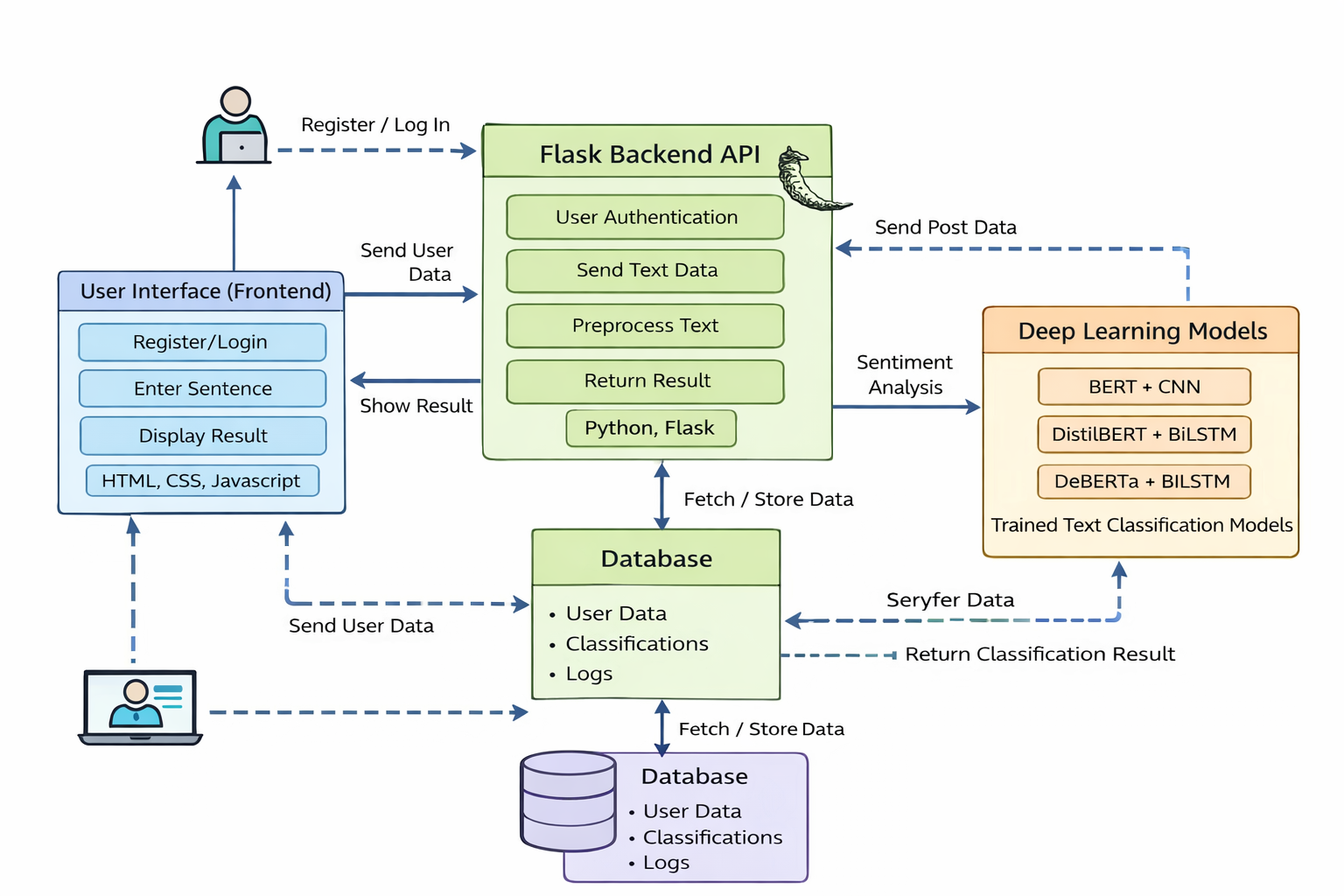
Specifications
H/W CONFIGURATION:
Processor - I3/Intel Processor
Hard Disk - 160GB
Key Board - Standard Windows Keyboard
Mouse - Two or Three Button Mouse
Monitor - SVGA
RAM - 8GB
S/W CONFIGURATION:
• Operating System : Windows 7/8/10
• Server side Script : HTML, CSS, Bootstrap & JS
• Programming Language : Python
• Libraries : Flask, Pandas, MySQL. Connector, Scikit-Learn, pytorch
• IDE/Workbench : VS Code
• Technology : Python 3.8+
• Server Deployment : Xampp Server


Related Projects
 Paper Publishing

Request Call Back
Would you like to receive a free callback now?
Choose the best time for callback:
Leave your message and we will contact you as soon as possible

6-2-85/B, Old Maternity Hospital Road, Thyagaraja Nagar, Tirupati, Andhra Pradesh – 517501
+91 9030333433
+91 9393939065
0877-2261612

Disclaimer - Takeoff Edu Group Projects are not associated or affiliated with IEEE in any way. The IEEE Projects mentioned here are mentioned in the context of student projects, whose ideas are derived from IEEE publications, not projects of or by IEEE.

