Early detection of rheumatoid arthritis in adults.
Objective
The objective of this project is to develop a system for the early detection of rheumatoid arthritis (RA) in adults using machine learning techniques, including CNN, Random Forest, XGBoost, and LightGBM. By analyzing medical data such as blood test results, imaging, and clinical parameters, the system aims to identify early signs of RA, enabling timely intervention. These models will be trained to recognize patterns in the data, utilizing advanced preprocessing, feature selection, and classification techniques to predict RA onset. Early detection using these models will help reduce long-term joint damage and improve the quality of life for affected individuals. The system aims to provide healthcare professionals with an automated, reliable tool for early diagnosis and intervention planning.
Abstract
Early detection of rheumatoid arthritis (RA) is crucial for timely intervention and effective management of the disease, which can significantly reduce the risk of joint damage and improve patient outcomes. This study presents a machine learning-based framework for predicting the early risk of RA in adults using clinical and laboratory data. The dataset consists of key patient features such as age, gender, clinical notes, symptom duration, Erythrocyte Sedimentation Rate (ESR), C-Reactive Protein (CRP), Rheumatoid Factor (RF) status, and Anti-Cyclic Citrullinated Peptide (Anti-CCP) status. The target variable, Early_RA_Risk, classifies patients into three categories: High, Medium, and Low risk. Various machine learning algorithms, including Convolutional Neural Networks (CNN), Random Forest, XGBoost, and LightGBM, are employed to train the predictive models. The study aims to evaluate the accuracy and performance of these models in classifying patients based on their likelihood of developing rheumatoid arthritis. By leveraging data-driven insights, this framework aims to assist healthcare professionals in identifying at-risk individuals, enabling early intervention and better management strategies. The results highlight the potential of machine learning in improving the early detection and prognosis of rheumatoid arthritis, contributing to more personalized and effective treatment plans for patients.
KEYWORDS: Early detection of rheumatoid arthritis (RA) using machine learning techniques, including Random Forest, XGBoost, LightGBM, and CNN, classifies patients based on clinical data like ESR, CRP, and Anti-CCP status. The goal is to predict Early_RA_Risk (High, Medium, Low) for timely intervention. This approach enhances disease prediction and personalized healthcare strategies for RA management.
NOTE: Without the concern of our team, please don't submit to the college. This Abstract varies based on student requirements.
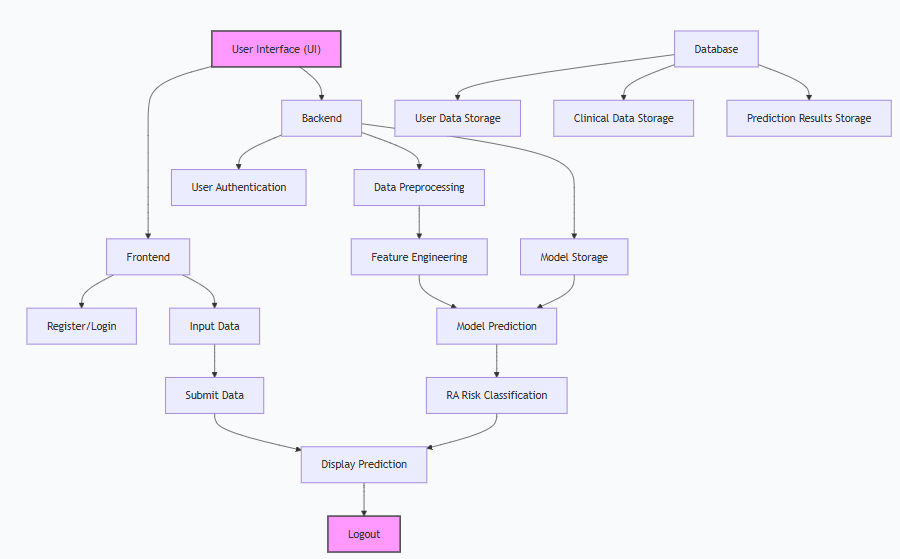
Block Diagram
Specifications
SOFTWARE REQUIREMENS
Operating System : Windows 7/8/10
Server side Script : HTML, CSS, Bootstrap & JS
Programming Language : Python
Libraries Flask, Pandas, Torch, Keras, Sklearn, Numpy , Seaborn
IDE/Workbench : VSCode
Technology : Python 3.6+
Server Deployment : Xampp Server
Database : MySQL
HARDWARE REQUIREMENTS
Processor - I3/Intel Processor
RAM - 8GB (min)
Hard Disk - 128 GB
Key Board - Standard Windows Keyboard
Mouse - Two or Three Button Mouse
Monitor - Any

Demo Video


Request for Video
Related Projects
 Paper Publishing
Request Call Back
Would you like to receive a free callback now?
Choose the best time for callback:
Leave your message and we will contact you as soon as possible

6-2-85/B, Old Maternity Hospital Road, Thyagaraja Nagar, Tirupati, Andhra Pradesh – 517501
+91 9030333433
+91 9393939065
0877-2261612

Disclaimer - Takeoff Edu Group Projects are not associated or affiliated with IEEE in any way. The IEEE Projects mentioned here are mentioned in the context of student projects, whose ideas are derived from IEEE publications, not projects of or by IEEE.

