Dynamic Partial Reconfigurable FIR Filter
Objective
Finite Impulse Response (FIR) filters are fundamental building blocks in digital signal processing systems due to their inherent stability and linear phase characteristics. Among various structures, the transposed FIR filter architecture is widely preferred for high-speed and hardware-efficient implementations because it enables parallel multiply–accumulate operations and reduces critical path delay
Abstract
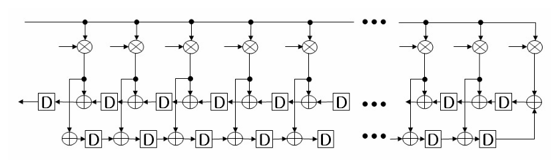
Abstract : Finite Impulse Response (FIR) filters are fundamental building blocks in digital signal processing systems due to their inherent stability and linear phase characteristics. Among various structures, the transposed FIR filter architecture is widely preferred for high-speed and hardware-efficient implementations because it enables parallel multiply–accumulate operations and reduces critical path delay. In this paper, we present the design and implementation of an n-tap transposed FIR filter based on the architecture shown in Fig. 1. The proposed design realizes the FIR filtering operation by arranging multipliers, adders, and delay elements in a transposed form, allowing efficient pipelining and improved throughput. The filter computes the output as a weighted sum of the current and previous input samples, where each tap corresponds to a coefficient multiplier followed by accumulation. The architecture is described using hardware description language (HDL) and synthesized for FPGA implementation to demonstrate its suitability for reconfigurable digital signal processing applications. The proposed implementation highlights simplicity, scalability with respect to the number of taps, and suitability for high-speed FPGA-based DSP systems.
NOTE: Without the concern of our team, please don't submit to the college. This Abstract varies based on student requirements.
Block Diagram
Specifications
Specifications:
Software Requirements:
VIVADO 2018.3
Hardware Requirements:
· Microsoft® Windows XP
· Intel® Pentium® 4 processor or Pentium 4 equivalent with SSE support
· 512 MB RAM
· 100 MB of available disk space
Learning Outcomes
- Basics of Digital Electronics
- VLSI design Flow
- Applications in real time
· VIVADO for design and simulation
· Solution providing for real time problems
· Project Development Skills:
o Problem Analysis Skills
o Problem Solving Skills
o Logical Skills
o Designing Skills
o Testing Skills
o Debugging Skills
o Presentation Skills
o Thesis Writing Skills
Demo Video


Request for Video
Related Projects
 Paper Publishing
Request Call Back
Would you like to receive a free callback now?
Choose the best time for callback:
Leave your message and we will contact you as soon as possible

6-2-85/B, Old Maternity Hospital Road, Thyagaraja Nagar, Tirupati, Andhra Pradesh – 517501
+91 9030333433
+91 9393939065
0877-2261612

Disclaimer - Takeoff Edu Group Projects are not associated or affiliated with IEEE in any way. The IEEE Projects mentioned here are mentioned in the context of student projects, whose ideas are derived from IEEE publications, not projects of or by IEEE.

