Durian Leaf Diseases Identification Using Deep Learning
Objective
This project presents a deep learning–based system for identifying seven durian leaf diseases using image classification. It evaluates three established architectures—ResNet50, DenseNet121, and ConvNeXt-Tiny—along with a lightweight MobileNet model implemented in PyTorch. The workflow includes dataset preprocessing, augmentation, training, validation, and comparative performance analysis using accuracy, precision, recall, F1-score, and confusion matrices. MobileNet is highlighted for its efficiency and suitability for fast, low-resource inference. A Flask web application enables users to register, log in, upload leaf images, and obtain disease predictions through a web based interface. The system emphasizes stable performance, reduced computational cost, and accessible deployment. Overall, it delivers a complete framework for automated detection of durian leaf diseases.
Abstract
This project focuses on identifying diseases in durian leaf’s using deep learning methods trained on seven categories of leaf conditions, including anthracnose, canker, fruit rot, mealybug infestation, pink disease, sooty mold, stem blight, stem cracking with gummosis, thrips disease, and yellow leaf. The system explores four models: ResNet50, DenseNet121, ConvNeXt-Tiny, and a custom hybrid CNN-Transformer architecture developed in PyTorch. The aim is to design an automated classification framework that assists in detecting disease patterns from leaf images with stable accuracy and efficient processing. The project includes a Flask-based application with modules for home, registration, login, classification, and logout, supported by
HTML, CSS, and JavaScript on the front end.
The proposed solution offers a structured workflow for dataset handling, model training, performance comparison, and deployment. The hybrid architecture is emphasized to combine spatial feature extraction with attention-based refinement, supporting improved recognition of subtle disease traits. The study highlights clear steps for data preparation, augmentation, model optimization, and integration into an accessible interface.
Keywords: durian leaf, disease identification, deep learning, CNN, Transformer, PyTorch, Flask, classification, ConvNeXt, DenseNet
NOTE: Without the concern of our team, please don't submit to the college. This Abstract varies based on student requirements.
Block Diagram
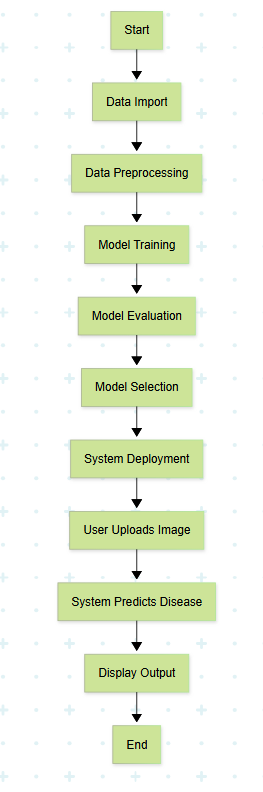
Specifications
H/W CONFIGURATION:
Processor - I3/Intel Processor
Hard Disk - 160GB
Key Board - Standard Windows Keyboard
Mouse - Two or Three Button Mouse
Monitor - SVGA
RAM - 8GB
S/W CONFIGURATION:
• Operating System : Windows 7/8/10
• Server side Script : HTML, CSS, Bootstrap & JS
• Programming Language : Python
• Libraries : Flask, Pandas, MySQL. Connector, Scikit-Learn, pytorch
• IDE/Workbench : VS Code
• Technology : Python 3.8+
• Server Deployment : Xampp Server

Demo Video


Request for Video
Related Projects
 Paper Publishing
Request Call Back
Would you like to receive a free callback now?
Choose the best time for callback:
Leave your message and we will contact you as soon as possible

6-2-85/B, Old Maternity Hospital Road, Thyagaraja Nagar, Tirupati, Andhra Pradesh – 517501
+91 9030333433
+91 9393939065
0877-2261612

Disclaimer - Takeoff Edu Group Projects are not associated or affiliated with IEEE in any way. The IEEE Projects mentioned here are mentioned in the context of student projects, whose ideas are derived from IEEE publications, not projects of or by IEEE.

