Domain name server (DNS) filtering service using Threat intelligence feeds and AIML Techniques
Objective
This study aims to develop a robust network security system using a two-factor approach, combining signature-based and anomaly-based detection systems. Leveraging machine learning algorithms, the objective is to enhance the accuracy and efficiency of detecting packet-based cyber attacks.
Abstract
Cybersecurity threats constantly evolve, necessitating robust detection mechanisms. This study proposes a twofactor approach combining signaturebased and anomalybased detection systems for identifying packetbased attacks. Leveraging machine learning algorithms—Decision Trees, Random Forest, and GaussianNB—the system aims to enhance detection accuracy and efficiency. Signaturebased detection relies on known patterns, while anomalybased detection identifies deviations from established norms. The study evaluates the performance of these algorithms in detecting attacks on network packets. Through comprehensive experimentation and analysis, this research assesses the efficacy of each algorithm in accurately pinpointing various types of attacks. Results showcase the strengths and limitations of each model in detecting sophisticated attacks. The findings underscore the importance, harnessing the strengths of both signature and anomaly detection, and demonstrate the potential of machine learning algorithms in fortifying network security against evolving cyber threats.
Keywords: Decision Tree, Random Forest, GaussianNB. MLP Classifier
NOTE: Without the concern of our team, please don't submit to the college. This Abstract varies based on student requirements.
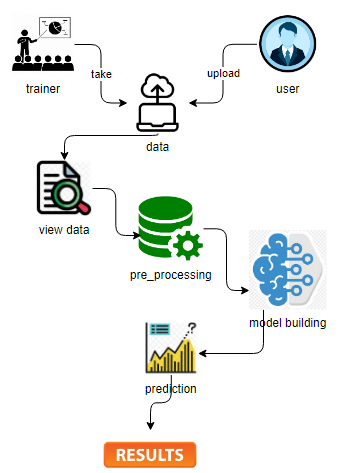
Block Diagram
Specifications
H/W SPECIFICATIONS:
• Processor I5/Intel Processor
• RAM 8GB (min)
• Hard Disk 128 GB
• Key Board Standard Windows Keyboard
• Mouse Two or Three Button Mouse
• Monitor Any
S/W SPECIFICATIONS:
• Operating System : Windows 10
• Serverside Script : Python 3.6
• IDE : Jupyter Notebook
• Libraries Used : Pandas, NumPy, ScikitLearn.


Related Projects
 Paper Publishing

Request Call Back
Would you like to receive a free callback now?
Choose the best time for callback:
Leave your message and we will contact you as soon as possible

6-2-85/B, Old Maternity Hospital Road, Thyagaraja Nagar, Tirupati, Andhra Pradesh – 517501
+91 9030333433
+91 9393939065
0877-2261612

Disclaimer - Takeoff Edu Group Projects are not associated or affiliated with IEEE in any way. The IEEE Projects mentioned here are mentioned in the context of student projects, whose ideas are derived from IEEE publications, not projects of or by IEEE.

