Dog Breed Classification using DL
Objective
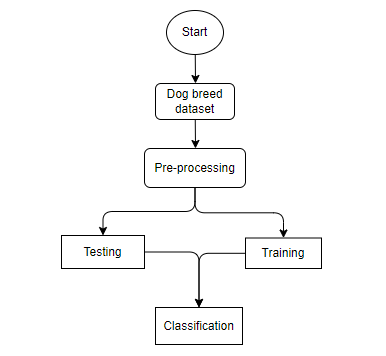
The goal of Dog Breed Classification using Deep Learning (DL) is to create an automated system that is reliable and accurate and can recognize and classify various dog breeds from input photographs. The system seeks to learn detailed traits and patterns unique to each breed through the use of DL techniques like Convolutional Neural Networks (CNNs), which will allow it to make accurate predictions. Numerous real-world uses for this classification exist, such as pet adoption, veterinary diagnostics, and research. The algorithm can help to reduce human error, save time, and provide important insights into the genetic and phenotypic variances across different dog breeds by obtaining high classification accuracy.
Abstract
In this paper, we have proposed two models to classify dogs according to their breeds. Since the classification of dogs is becoming very difficult and moreover, these classifications are taken on the deep learning concept and training a fully defined data set helps in training both models which predicts the different accuracy levels at both ends. Since every now and then predictions are taken for every model. During the study, we came across many types of functionality levels that were not taken in previous studies too. Also, our approach also works on the main concept of transfer learning which deals with data augmentation technique with its properties to increase the size of data set, after which accuracy levels are matched or it is compared with both the models so that a comparison can be made for both the models and the classification is also done with a profound approach.
NOTE: Without the concern of our team, please don't submit to the college. This Abstract varies based on student requirements.
Block Diagram
Specifications
SOFTWARE FRONT END REQUIREMENTS
H/W CONFIGURATION:
H/W Specifications:
Processor:I5/Intel Processor
RAM:8GB (min)
Hard Disk: 128 GB
S/W Specifications:
Operating System: Windows 10
Server-side Script: Python 3.6
IDE:PyCharm, Jupyter notebook
Libraries Used:Numpy, IO, OS, Flask, Keras, pandas, tensorflow


Related Projects
 Paper Publishing

Request Call Back
Would you like to receive a free callback now?
Choose the best time for callback:
Leave your message and we will contact you as soon as possible

6-2-85/B, Old Maternity Hospital Road, Thyagaraja Nagar, Tirupati, Andhra Pradesh – 517501
+91 9030333433
+91 9393939065
0877-2261612

Disclaimer - Takeoff Edu Group Projects are not associated or affiliated with IEEE in any way. The IEEE Projects mentioned here are mentioned in the context of student projects, whose ideas are derived from IEEE publications, not projects of or by IEEE.

