Dibetes prdiction based on body and sysmptoms parameters
Objective
The primary objective of this project is to develop a machine learning-based diabetes prediction system that integrates both clinical and symptom-based datasets for accurate risk assessment. The study aims to train and evaluate advanced machine learning models, including ANN, LSTM, Random Forest, and XGBoost, to identify patterns that indicate the likelihood of diabetes onset. The models will be assessed using key performance metrics such as accuracy, precision, recall, and F1-score to determine their effectiveness. Additionally, the project seeks to develop a web-based interface that allows healthcare professionals and individuals to input patient data and receive real-time diabetes risk predictions. Future objectives include optimizing model performance through hyperparameter tuning, incorporating additional datasets for improved generalizability, and integrating explainable AI techniques to enhance interpretability and trust in the prediction system.
Abstract
DIABETES PREDICTION BASED ON BODY AND SYMPTOMS PARAMETERS
ABSTRACT:
This study focuses on utilizing machine
learning algorithms—Artificial Neural Networks (ANN), Long Short-Term Memory
(LSTM), Random Forest, and XGBoost—to predict the onset of diabetes by
analyzing two distinct datasets. The first dataset comprises clinical measures
such as age, plasma glucose concentration, BMI, and family history, while the
second dataset includes symptom-based features like polyuria, polydipsia,
weight loss, and visual blurring. By leveraging these diverse datasets, the
models aim to identify hidden patterns that indicate diabetes risk. The study
evaluates model performance using key metrics, including accuracy, precision,
recall, and F1-score, to ensure reliability. The results demonstrate that
XGBoost and Random Forest exhibit strong predictive performance by effectively
capturing complex relationships between clinical and symptom-based data.
Meanwhile, ANN and LSTM offer additional insights into non-linear patterns,
enhancing the model’s ability to detect subtle correlations within the data.
The primary goal of this research is to assist healthcare professionals in making early and accurate diabetes diagnoses, ultimately improving patient care and facilitating timely intervention. To enhance accessibility, the system will be integrated into a user-friendly web-based interface, enabling easy diabetes risk predictions. This approach fosters proactive healthcare strategies, empowering both medical practitioners and individuals to assess diabetes risk efficiently. Future work will focus on optimizing model performance through advanced hyperparameter tuning and integrating real-time data to improve predictive robustness.
Keywords: Diabetes Prediction, Machine Learning, ANN, LSTM, Random Forest, XGBoost, Healthcare, Predictive Models, Early Diagnosis, Clinical Data, Symptom-Based Data, Web-Based Diagnosis System.
NOTE: Without the concern of our team, please don't submit to the college. This Abstract varies based on student requirements.
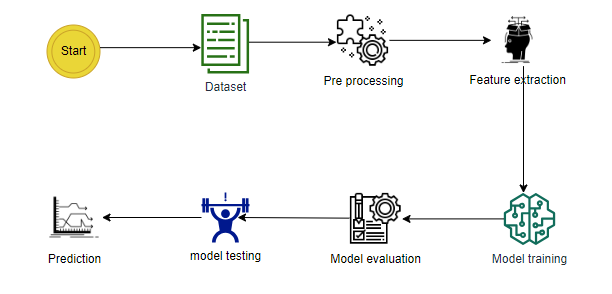
Block Diagram
Specifications
4.2 H/W CONFIGURATION:
u Processor - I3/Intel Processor
u Hard Disk -160 GB
u RAM - 8 GB
4.3 S/W CONFIGURATION:
u Operating System : Windows 7/8/10 .
u Server side Script : HTML, CSS & JS.
u IDE : Vscode
u Libraries Used : Numpy, Pandas,Sklearn,Tensorflow
u Technology : Python 3.6+.


Related Projects
 Paper Publishing

Request Call Back
Would you like to receive a free callback now?
Choose the best time for callback:
Leave your message and we will contact you as soon as possible

6-2-85/B, Old Maternity Hospital Road, Thyagaraja Nagar, Tirupati, Andhra Pradesh – 517501
+91 9030333433
+91 9393939065
0877-2261612

Disclaimer - Takeoff Edu Group Projects are not associated or affiliated with IEEE in any way. The IEEE Projects mentioned here are mentioned in the context of student projects, whose ideas are derived from IEEE publications, not projects of or by IEEE.

