Detection of Apple Plant Diseases Using Leaf Images Through Convolutional Neural Network
Objective
The project aims to develop a streamlined CNN model for identifying apple plant diseases from leaf images. It focuses on designing an efficient architecture, applying data augmentation, using a relevant dataset, training and evaluating the model, comparing it with existing models, exploring deployment on handheld devices, and documenting the process. The goal is to enhance automated plant disease detection for apple crops, aiding farmers in crop management and yield improvement.
Abstract
Plant diseases are a severe cause of crop losses in the agriculture globally. Detection of diseases in plants is difficult and challenging due to the lack of expert knowledge. Deep learning-based models provide promising ways to identify plant diseases using leaf images. However, need of larger training sets, computational complexity, and overfitting, etc. are the major issues with these techniques that still need to be addressed. In this work, a convolutional neural network (CNN) is developed that consists of smaller number of layers leading to lower computational burden. Some augmentation techniques such as shift, shear, scaling, zoom, and flipping are applied to generate additional samples increasing the training set without actually capturing more images. The CNN model is trained for apple crop using a publicly available dataset Plant Village to identify Scab, Black rot, and Cedar rust diseases in apple leaves. The rigorous experimental results revealed that the proposed model is well fit to identify apple leaf diseases and achieves 98% classification accuracy. It is also evident from the results that it needs lesser amount of storage and takes smaller execution time than several existing deep CNN models. Although, there exist several CNN models for crop disease detection with comparable accuracy, but the proposed model needs lower storage and computational resources. Therefore, it is highly suitable for deploying in handheld devices
KEYWORDS: plant diseases, crop losses, agriculture, deep learning, convolutional neural network (CNN), smaller network layers, augmentation techniques, shift, shear, scaling, zoom, flipping, training set augmentation, apple crop, Plant Village dataset, Scab, Black rot, Cedar rust, classification accuracy, storage efficiency, computational efficiency, handheld devices
NOTE: Without the concern of our team, please don't submit to the college. This Abstract varies based on student requirements.
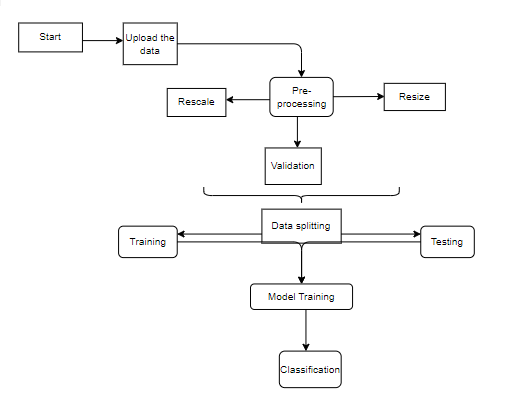
Block Diagram
Specifications
H/W CONFIGURATION:
Processor : I3/Intel Processor
Hard Disk : 160GB
Key Board : Standard Windows Keyboard
Mouse : Two or Three Button Mouse
Monitor : SVGA
RAM : 8GB
S/W CONFIGURATION:
Operating System : Windows 7/8/10
Programming Language : Python
Libraries : Pandas, Mysql:connector, Os, Pillow.
IDE/Workbench : VS:code
Technology : Python 3.10+
Server Deployment : Mysql Server

Demo Video


Request for Video
Related Projects
 Paper Publishing
Request Call Back
Would you like to receive a free callback now?
Choose the best time for callback:
Leave your message and we will contact you as soon as possible

6-2-85/B, Old Maternity Hospital Road, Thyagaraja Nagar, Tirupati, Andhra Pradesh – 517501
+91 9030333433
+91 9393939065
0877-2261612

Disclaimer - Takeoff Edu Group Projects are not associated or affiliated with IEEE in any way. The IEEE Projects mentioned here are mentioned in the context of student projects, whose ideas are derived from IEEE publications, not projects of or by IEEE.

