Detecting Road Damages Pothole Detection
Objective
The main objective of this project is to detect the road damage using deep learning techniques
Abstract
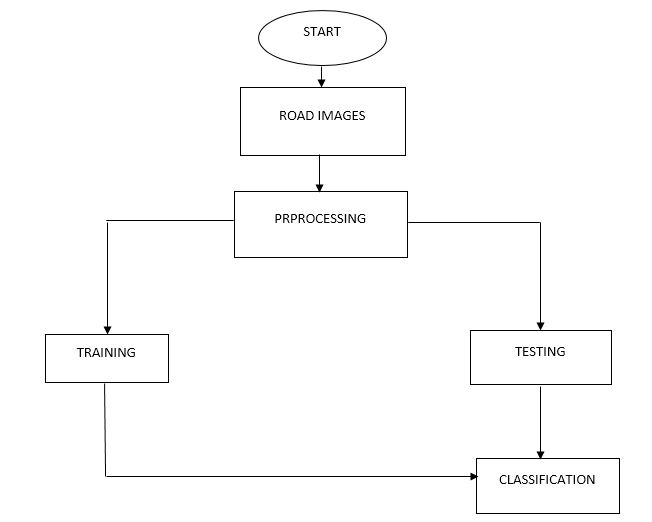
Pothole is one of the major types of defects frequently found on the road whose assessment is necessary to process. It is one of the important reason of accidents on the road along with the wear and tear of vehicles. Road defects assessment is to be done through defects data collection and processing of this collected data. Currently, using various types of imaging systems data collection is near about becomes automated but an assessment of defects from collected data is still manual. Manual classification and evaluation of potholes are expensive, labour-intensive, and time-consuming and thus slows down the overall road maintenance process. This paper describe a method for classification and detection of the potholes on road images using convolutional neural networks which are deep learning algorithms. In the proposed system we used convolutional neural networks based approach with pre-trained models to classify given input images into a pothole and non-pothole categories. The method was implemented in python using OpenCV library under windows and colab environment, trained raw images. The results are evaluated and compared for convolutional neural networks and various seven pre-trained models through accuracy, precision and recall metrics. The results show that pre-trained models ResNetV2, ResNet50 and VGG19 can detect potholes on road images with reasonably good accuracy.
NOTE: Without the concern of our team, please don't submit to the college. This Abstract varies based on student requirements.
Block Diagram
Specifications
Hardware:
Operating system : Windows 7 or 7+
RAM : 8 GB
Hard disc or SSD : More than 500 GB
Processor : Intel 3rd generation or high or Ryzen with 8 GB Ram
Software:
Software’s : Python 3.6 or high version
IDE : PyCharm.
Libraries Used : Numpy, IO, OS, Flask, keras, pandas, tensorflow
Learning Outcomes
- Practical exposure to
- Hardware and software tools
- Solution providing for real time problems
- Working with team/individual
- Work on creative ideas
- Testing techniques
- Error correction mechanisms
- What type of technology versions is used?
- Working of Tensor Flow
- Implementation of Deep Learning techniques
- Working of CNN algorithm
- Working of Transfer Learning methods
- Building of model creations
- Scope of project
- Applications of the project
- About Python language
- About Deep Learning Frameworks
- Use of Data Science


Related Projects
 Paper Publishing

Request Call Back
Would you like to receive a free callback now?
Choose the best time for callback:
Leave your message and we will contact you as soon as possible

6-2-85/B, Old Maternity Hospital Road, Thyagaraja Nagar, Tirupati, Andhra Pradesh – 517501
+91 9030333433
+91 9393939065
0877-2261612

Disclaimer - Takeoff Edu Group Projects are not associated or affiliated with IEEE in any way. The IEEE Projects mentioned here are mentioned in the context of student projects, whose ideas are derived from IEEE publications, not projects of or by IEEE.

