Designing a High-Speed, Low-Area Three-Operand Binary Adder using Kogge-Stone, Han-Carlson, and Ladner-Fischer VLSI Architectures
Objective
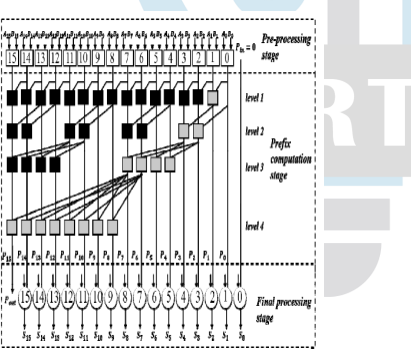
Leverage Parallel-Prefix Architectures • Explore and design three-operand addition using Kogge-Stone (KS) prefix tree to minimize delay. • Use Han-Carlson (HCA) architecture to balance speed and area — HCA offers a compromise: relatively low depth with less wiring / gate complexity than full Kogge-Stone. • Use Ladner-Fischer (LF) prefix architecture for its low logic-depth and manageable fan-out, aiming to reduce delay and possibly area.
Abstract
High-speed arithmetic units are critical components in modern VLSI systems, particularly in processors, digital signal processing (DSP) blocks, and communication hardware. Among these, multi-operand addition plays a vital role in applications such as multiplication, accumulation, and arithmetic logic units (ALUs). Conventional binary adders are primarily designed for two-operand addition, leading to increased delay and area when extended to handle three operands through cascading structures. This work presents the design of a high-speed, low-area three-operand binary adder using the Kogge-Stone parallel prefix architecture. By efficiently combining carry-save techniques with fast carry-propagation using Kogge-Stone logic, the proposed design significantly reduces critical path delay while maintaining area efficiency. The architecture is well suited for high-performance and low-latency digital systems.
NOTE: Without the concern of our team, please don't submit to the college. This Abstract varies based on student requirements.
Block Diagram
Specifications
Software Requirements
• Xilinx Vivado Design Suite (2020.2 or later)
• Verilog HDL for RTL design and synthesis
• Vivado Simulator (XSIM) for functional and timing analysis
• MATLAB (optional) for result verification and performance analysis
Hardware Requirements
• Microsoft® Windows 10 / Windows 11 (64-bit)
• Intel® Core™ i5 / i7 Processor or equivalent
• Minimum 8 GB RAM
• Minimum 500 MB free disk space
Learning Outcomes
Learning Outcomes
• Understand the concept of multi-operand binary addition.
• Learn the role of Carry Save Adders in high-speed arithmetic.
• Analyze the Kogge-Stone parallel prefix adder architecture.
• Gain insights into area–delay trade-offs in VLSI adder design.
• Develop skills in designing high-performance arithmetic circuits using Verilog HDL.


Related Projects
 Paper Publishing

Request Call Back
Would you like to receive a free callback now?
Choose the best time for callback:
Leave your message and we will contact you as soon as possible

6-2-85/B, Old Maternity Hospital Road, Thyagaraja Nagar, Tirupati, Andhra Pradesh – 517501
+91 9030333433
+91 9393939065
0877-2261612

Disclaimer - Takeoff Edu Group Projects are not associated or affiliated with IEEE in any way. The IEEE Projects mentioned here are mentioned in the context of student projects, whose ideas are derived from IEEE publications, not projects of or by IEEE.

