Design & Verification of Reconfigurable SRAM Controller with AMBA AXI Protocol Interface for Automobile Application
Objective
Develop a Reconfigurable SRAM Controller • To design an SRAM controller whose behavior/configuration can adapt to different requirements (e.g., memory size, access patterns) — “reconfigurable” means it’s not a fixed, one-size-fits-all controller. • Make this controller suitable for automotive systems, which often have varying memory demands depending on the subsystem (infotainment, ADAS, etc.).
Abstract
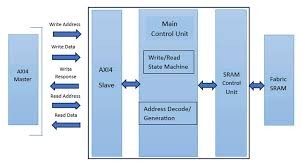
The Static Random Access Memory SRAM Controller with AXI is intended to improve the read/write memory access time and internal connectivity of the semiconductor. Static random-access memory is used by one shared bus, with the aid of Advanced Microcontroller Bus Architecture AMBA. Utilizing System Verilog technology, the system's functionality of SRAM with AXI is ensured. The SRAM, which is designed is reconfigurable to different memory and AXI data and address widths. All of the modules in SV's basic test framework are hardwired to one another, which limits reusability. Industrial standard utilizes the Universal Verification Methodology UVM as its standard verification methodology. It reflects quick developments that allow the user to design reliable and reusable test bench components and verification intellectual property. In hardware modelling of an automobile, SRAM plays a vital role in memory. Even though SRAM is more expensive, it is faster and uses significantly less power compared to DRAM. SRAM can be used where either bandwidth or lower or both are principal constraints. SRAM is easier to control and also to interface. Since SRAM is less dense, it is used in automotives. SRAM has a high-speed serial interface with the processor through AXI and with the peripherals through APB. By offering a scalable, power-efficient, and AXI-compliant SRAM controller, this work advances automotive memory management and guarantees improved system performance and reliability.
NOTE: Without the concern of our team, please don't submit to the college. This Abstract varies based on student requirements.
Block Diagram

Learning Outcomes
1. Understand SRAM architecture and controller design for embedded systems.
2. Learn the AMBA AXI protocol and its integration with memory controllers.
3. Gain hands-on experience with SystemVerilog-based design and verification.
4. Learn design for reconfigurability, scalability, and high performance.
5. Develop skills in FPGA/SoC implementation, simulation, and verification.
6. Understand memory access optimization and real-time embedded system requirements for automotive applications.
Demo Video


Request for Video
Related Projects
 Paper Publishing
Request Call Back
Would you like to receive a free callback now?
Choose the best time for callback:
Leave your message and we will contact you as soon as possible

6-2-85/B, Old Maternity Hospital Road, Thyagaraja Nagar, Tirupati, Andhra Pradesh – 517501
+91 9030333433
+91 9393939065
0877-2261612

Disclaimer - Takeoff Edu Group Projects are not associated or affiliated with IEEE in any way. The IEEE Projects mentioned here are mentioned in the context of student projects, whose ideas are derived from IEEE publications, not projects of or by IEEE.

