Design and implementation of MOD60 counter based on Multisim
Objective
The objective of this project is to design and implement a MOD60 counter using Multisim for accurate counting and timing applications. It focuses on developing a digital counter capable of counting from 0 to 59 and resetting automatically after reaching the maximum count. The design will be created and simulated in Multisim to verify its functional correctness and timing behavior. The project aims to optimize the circuit for simplicity, reliability, and low power consumption. The overall goal is to demonstrate the practical realization of sequential digital logic design using simulation tools.
Abstract
NOTE: Without the concern of our team, please don't submit to the college. This Abstract varies based on student requirements.
Block Diagram
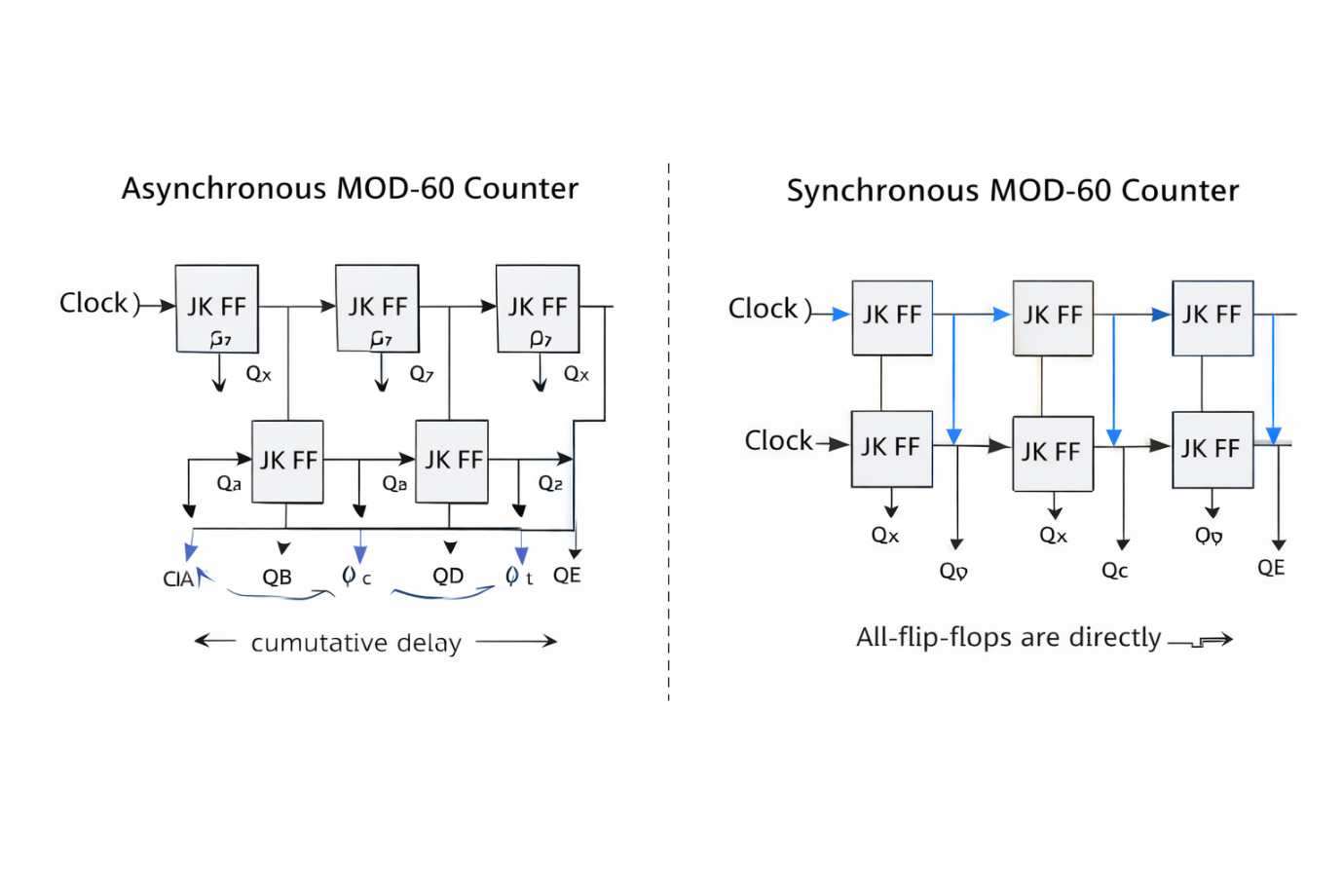
Specifications
Software Requirements:
· Xilinx ISE14.7 Suite/Vivado2018.3 Tool.
· HDL: Verilog.
Hardware Requirements:
· Microsoft® Windows XP.
· Intel® Pentium® 4 processor or Pentium 4 equivalent with SSE support.
· 512 MB RAM.
· 100 MB of available disk space.
Learning Outcomes
· Understand the working principles of asynchronous and synchronous counters
· Design MOD-60 counters using logic simulation tools
· Analyze propagation delay and timing characteristics
· Compare stability and performance of counter architectures
· Select appropriate counter types for different applications
· Gain hands-on experience with Multisim and Logisim


Related Projects
 Paper Publishing

Request Call Back
Would you like to receive a free callback now?
Choose the best time for callback:
Leave your message and we will contact you as soon as possible

6-2-85/B, Old Maternity Hospital Road, Thyagaraja Nagar, Tirupati, Andhra Pradesh – 517501
+91 9030333433
+91 9393939065
0877-2261612

Disclaimer - Takeoff Edu Group Projects are not associated or affiliated with IEEE in any way. The IEEE Projects mentioned here are mentioned in the context of student projects, whose ideas are derived from IEEE publications, not projects of or by IEEE.

