Design and Implementation of BIST Architecture for low power VLSI Applications using Verilog
Objective
The research investigates various power reduction techniques, including test pattern compression, selective clock gating, and power-aware test scheduling, to optimize power consumption during testing.
Abstract
This paper presents a comprehensive study on the design and implementation of a BIST architecture tailored for low-power VLSI applications, leveraging the Verilog hardware description language. The proposed BIST architecture integrates advanced power-aware testing techniques to minimize energy consumption during testing phases, ensuring compatibility with modern low-power design paradigms.
Through extensive simulations and empirical testing, we demonstrate the efficacy of this BIST architecture in efficiently detecting and diagnosing faults within low-power VLSI circuits while adhering to stringent power constraints. The results highlight the potential of this methodology to significantly enhance the reliability and power efficiency of VLSI systems, making it a valuable asset for designers in the pursuit of energy-efficient electronics.
NOTE: Without the concern of our team, please don't submit to the college. This Abstract varies based on student requirements.
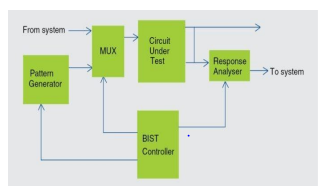
Block Diagram
Specifications
Software Requirements:
· Tool: Xilinx Vivado
· HDL: Verilog
Hardware Requirements:
- Microsoft® Windows XP
- Intel® Pentium® 4 processor or Pentium 4 equivalent with SSE support
- 512 MB RAM
- 100 MB of available disk space
Learning Outcomes
· Introduction to digital & analog electronics
· Understanding of VLSI Concepts
· Fundamentals of BIST
o BIST Architecture
o BIST Design Styles
· Knowledge on Verilog
· Low-Power Design Techniques
· Simulation & Verification
· Testing & Debugging skills
· Real world Applications


Related Projects
 Paper Publishing

Request Call Back
Would you like to receive a free callback now?
Choose the best time for callback:
Leave your message and we will contact you as soon as possible

6-2-85/B, Old Maternity Hospital Road, Thyagaraja Nagar, Tirupati, Andhra Pradesh – 517501
+91 9030333433
+91 9393939065
0877-2261612

Disclaimer - Takeoff Edu Group Projects are not associated or affiliated with IEEE in any way. The IEEE Projects mentioned here are mentioned in the context of student projects, whose ideas are derived from IEEE publications, not projects of or by IEEE.

