Design and evaluation of clock-gating-based approximate multiplier for error-tolerant applications
Objective
The objective of this project is to design and implement a clock-gating-based approximate multiplier that reduces power consumption in digital circuits. It aims to exploit error tolerance in applications to achieve energy-efficient computation while maintaining acceptable output quality. The project also seeks to evaluate the trade-offs between power, delay, area, and computational accuracy
Abstract
NOTE: Without the concern of our team, please don't submit to the college. This Abstract varies based on student requirements.
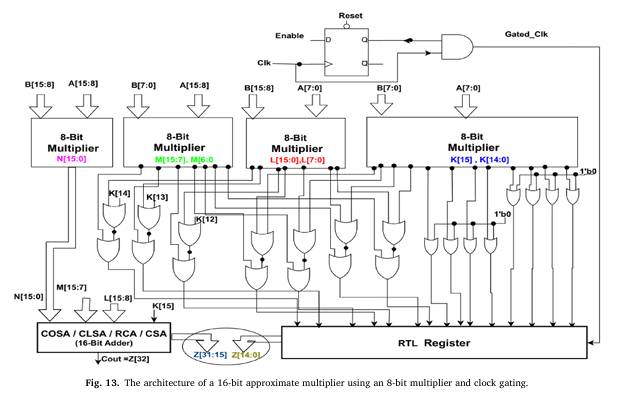
Block Diagram
Specifications
xilinx vivado
Learning Outcomes
Understand the concept of approximate computing and its trade-offs for power and accuracy.
Learn clock-gating techniques for dynamic power reduction in sequential circuits.
Gain skills in designing approximate multipliers for energy-efficient digital systems.
Analyze trade-offs between accuracy, power, delay, and area.
Implement and simulate digital arithmetic units using Verilog/VHDL.
Apply approximate arithmetic in real-time error-tolerant applications such as image processing and IoT.


Related Projects
 Paper Publishing

Request Call Back
Would you like to receive a free callback now?
Choose the best time for callback:
Leave your message and we will contact you as soon as possible

6-2-85/B, Old Maternity Hospital Road, Thyagaraja Nagar, Tirupati, Andhra Pradesh – 517501
+91 9030333433
+91 9393939065
0877-2261612

Disclaimer - Takeoff Edu Group Projects are not associated or affiliated with IEEE in any way. The IEEE Projects mentioned here are mentioned in the context of student projects, whose ideas are derived from IEEE publications, not projects of or by IEEE.

