Dementia Classification using deep learning approaches
Objective
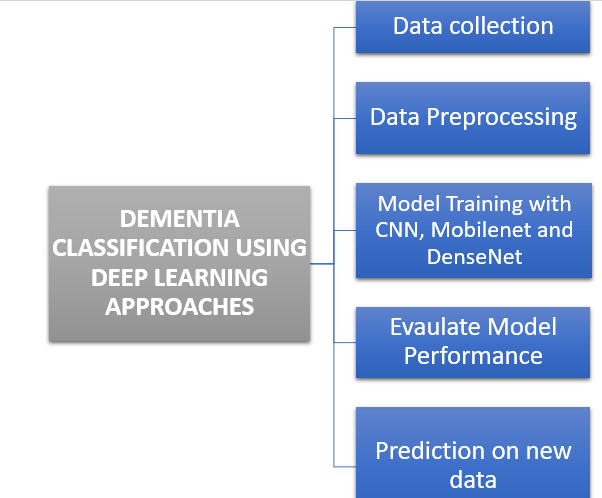
Dementia is a progressive neurological condition that impairs cognitive functions and affects millions worldwide this project titled "Dementia Classification using Deep Learning Approaches," leverages cutting-edge deep learning algorithms, including Convolutional Neural Networks (CNN), MobileNet, and DenseNet, to classify dementia into four distinct stages: No Impairment, Very Mild Impairment, Mild Impairment, and Moderate Impairment.
Abstract
"DEMENTIA CLASSIFICATION USING DEEP LEARNING APPROACHES"
Abstract
Dementia is a progressive neurological condition that impairs cognitive functions and affects millions worldwide. Early and accurate detection of its various stages is critical for effective management and treatment. This project, titled "Dementia Classification using Deep Learning Approaches," leverages cutting-edge deep learning algorithms, including Convolutional Neural Networks (CNN), MobileNet, and DenseNet, to classify dementia into four distinct stages: No Impairment, Very Mild Impairment, Mild Impairment, and Moderate Impairment. The model is trained on a robust and publicly available dataset of Alzheimer’s disease MRI scans, sourced from Kaggle. Data preprocessing and augmentation techniques ensure the model's resilience and accuracy. Comparative analysis of the three algorithms highlights DenseNet's high performance, achieving superior classification accuracy. The proposed system provides a reliable, efficient, and cost-effective diagnostic tool, empowering healthcare professionals with timely insights for better patient outcomes. By integrating lightweight yet powerful architectures like MobileNet, the project also ensures real-world applicability, especially in resource-constrained environments. This study aims to bridge the gap between early dementia detection and accessible diagnostic technology, paving the way for advancements in medical imaging analysis through deep learning.
Keywords
Dementia, Alzheimer's, MRI, deep learning, CNN, DenseNet, MobileNet, classification, early detection, medical imaging
NOTE: Without the concern of our team, please don't submit to the college. This Abstract varies based on student requirements.
Block Diagram
Specifications
SOFTWARE HARDWARE REQUIREMENTS
H/W CONFIGURATION:
Processor - I3/Intel Processor
Hard Disk - 160GB
Key Board - Standard Windows Keyboard
Mouse - Two or Three Button Mouse
Monitor - SVGA
RAM - 8GB
S/W CONFIGURATION:
• Operating System : Windows 7/8/10
• Server side Script : HTML, CSS, Bootstrap & JS
• Programming Language : Python
• Libraries : Flask, Pandas, MySQL. Connector, Tensor flow, Keras
• IDE/Workbench : VS Code
• Technology : Python 3.8+
• Server Deployment : Xampp Server

Demo Video


Request for Video
Related Projects
 Paper Publishing
Request Call Back
Would you like to receive a free callback now?
Choose the best time for callback:
Leave your message and we will contact you as soon as possible

6-2-85/B, Old Maternity Hospital Road, Thyagaraja Nagar, Tirupati, Andhra Pradesh – 517501
+91 9030333433
+91 9393939065
0877-2261612

Disclaimer - Takeoff Edu Group Projects are not associated or affiliated with IEEE in any way. The IEEE Projects mentioned here are mentioned in the context of student projects, whose ideas are derived from IEEE publications, not projects of or by IEEE.

