Deep Learning Innovations for Underwater Waste Detection
Objective
The objective of this project is to accurately detect and classify various types of underwater waste—including plastics, bottles, nets, cans, tires, electronics, gloves, and miscellaneous debris—using the advanced YOLOv11 deep learning algorithm. The project aims to build a highly efficient automated detection system capable of operating in complex underwater environments, where lighting variations, turbidity, and object distortion pose major challenges. By leveraging YOLOv11’s enhanced feature extraction and real-time processing capabilities, the system seeks to improve the monitoring and assessment of marine pollution. The ultimate goal is to support ocean conservation efforts by enabling precise, fast, and scalable identification of underwater waste.
Abstract
Underwater pollution has become a critical environmental challenge, threatening marine ecosystems and biodiversity due to the accumulation of plastic, metal, and other debris. This project presents an advanced Deep Learning–based Underwater Waste Detection System designed to accurately identify and classify various categories of underwater waste. Leveraging the cutting-edge YOLOv11 object detection framework, the system performs real-time detection across multiple waste classes, including masks, cans, bottles, nets, tires, gloves, electronics, plastics, and miscellaneous debris. The model is trained on a diverse underwater dataset and evaluated using key performance metrics such as precision, recall, mAP50, and mAP50-95. Results show strong detection capabilities in several classes such as cellphone, pbag, glove, mask, and net, while highlighting challenges in detecting smaller or visually ambiguous objects like metal, plastic, and rod. The system demonstrates the potential of deep learning to enhance marine waste monitoring by providing fast and accurate detection in complex underwater environments. By utilizing YOLOv11’s improved architecture and robust feature extraction, this work contributes to scalable, automated solutions for ocean conservation and supports future innovations in environmental surveillance technologies.
Keywords: Underwater Waste Detection, YOLOv11, Deep Learning, Marine Pollution, Object Detection, Environmental Monitoring, Real-Time Detection, Plastic Waste, Ocean Conservation, Computer Vision.
NOTE: Without the concern of our team, please don't submit to the college. This Abstract varies based on student requirements.
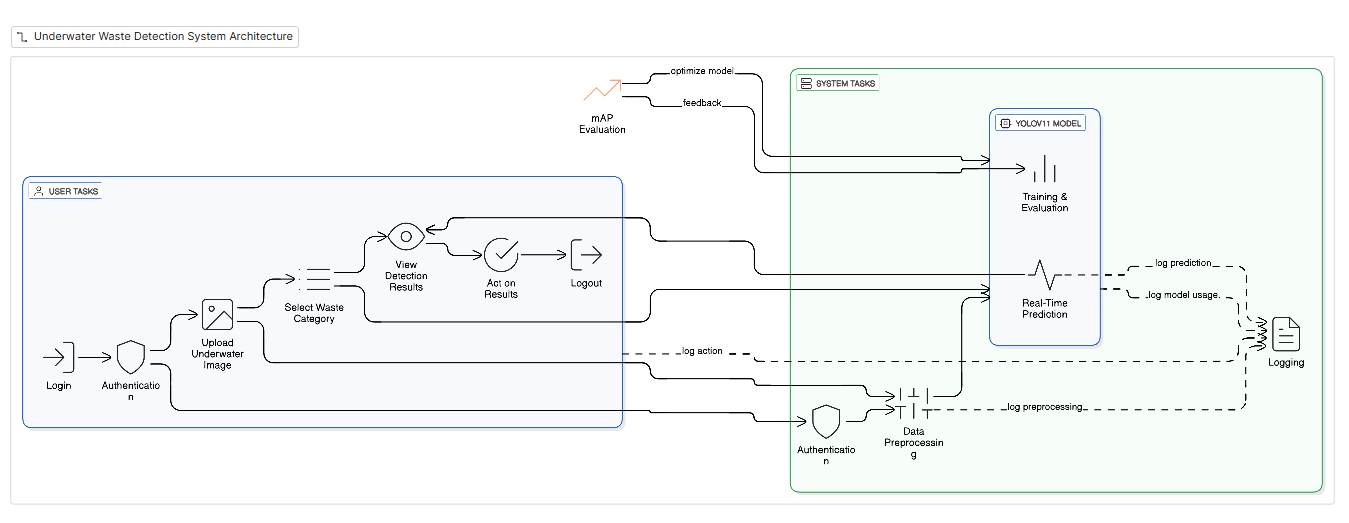
Block Diagram
Specifications
SOFTWARE REQUIREMENS
Operating System : Windows 7/8/10
Server side Script : streamlit
Programming Language : Python
Libraries : streamlit, Pandas, Torch, Keras, Sklearn, Numpy , Seaborn
IDE/Workbench : VSCode
Server Deployment : Xampp Server
Database : mysql
HARDWARE REQUIREMENTS
Processor - I3/Intel Processor
RAM - 8GB (min)
Hard Disk - 128 GB
Key Board - Standard Windows Keyboard
Mouse - Two or Three Button Mouse
Monitor - Any

Demo Video


Request for Video
Related Projects
 Paper Publishing
Request Call Back
Would you like to receive a free callback now?
Choose the best time for callback:
Leave your message and we will contact you as soon as possible

6-2-85/B, Old Maternity Hospital Road, Thyagaraja Nagar, Tirupati, Andhra Pradesh – 517501
+91 9030333433
+91 9393939065
0877-2261612

Disclaimer - Takeoff Edu Group Projects are not associated or affiliated with IEEE in any way. The IEEE Projects mentioned here are mentioned in the context of student projects, whose ideas are derived from IEEE publications, not projects of or by IEEE.

