Deep Learning Approach for Real and Fake News Classification
Objective
The primary objective of this project is to build an efficient and accurate deep learning-based system that can classify news articles as real or fake. This will involve several key steps, including the preprocessing of textual data, feature extraction, model development, and evaluation. The first objective is to gather a dataset of news articles labeled as real or fake, which will serve as the foundation for training the deep learning models. The next objective is to apply data preprocessing techniques to clean and prepare the dataset for analysis, including handling missing data, tokenizing text, and normalizing features. The third objective is to develop and train deep learning models such as RNN, LSTM, and BERT for the classification task. The system will need to be evaluated based on various performance metrics such as accuracy, precision, recall, and F1-score. Another objective is to ensure the scalability of the system, enabling it to handle large datasets efficiently. The project also aims to provide a user-friendly interface through a which users can input news articles for classification. Finally, the project will focus on achieving high accuracy in the classification task, ensuring that the system can reliably distinguish between real and fake news.
Abstract
The project "Deep Learning Approach for Real and Fake News Classification" aims to develop a system capable of automatically classifying news articles as real or fake. By utilizing deep learning algorithms such as Recurrent Neural Networks (RNN), Long Short-Term Memory (LSTM), and BERT-based Transformers, this research focuses on processing textual data to identify misleading or inaccurate news. The system is designed to evaluate news content and assign labels of 'real' or 'fake' based on its analysis. The key idea is to leverage the ability of deep learning models to understand language patterns and context within text, which enables accurate classification. The proposed system will be built using Python, Flask, and relevant front-end technologies. The dataset for training consists of news articles, each labeled as either real or fake, with text content as the primary feature. This approach seeks to improve news verification processes and provide users with reliable information by detecting fake news. The work is expected to contribute significantly to the growing field of text classification, with applications in content verification systems across various platforms.
Keywords: Deep Learning, Fake News Detection, RNN, LSTM, BERT, Text Classification, Python, Flask, Data Preprocessing, Machine Learning.
NOTE: Without the concern of our team, please don't submit to the college. This Abstract varies based on student requirements.
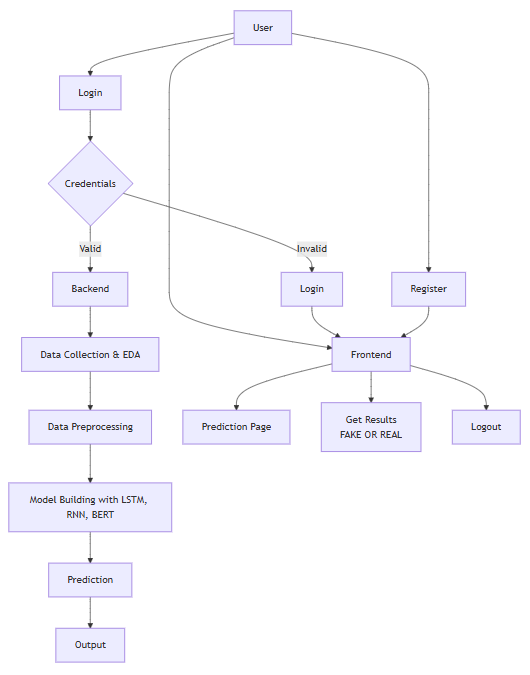
Block Diagram
Specifications
Hardware Requirements
Processor - I3/Intel Processor
Hard Disk - 160GB
Key Board - Standard Windows Keyboard
Mouse - Two or Three Button Mouse
Monitor - SVGA
RAM - 8GB
Software Requirements:
Operating System : Windows 7/8/10
Server side Script : HTML, CSS, Bootstrap & JS
Programming Language : Python
Libraries : Flask/Django, Pandas, Mysql.connector, Os, Numpy
IDE/Workbench : PyCharm
Technology : Python 3.6+
Server Deployment : Xampp Server
Database : MySQL


Related Projects
 Paper Publishing

Request Call Back
Would you like to receive a free callback now?
Choose the best time for callback:
Leave your message and we will contact you as soon as possible

6-2-85/B, Old Maternity Hospital Road, Thyagaraja Nagar, Tirupati, Andhra Pradesh – 517501
+91 9030333433
+91 9393939065
0877-2261612

Disclaimer - Takeoff Edu Group Projects are not associated or affiliated with IEEE in any way. The IEEE Projects mentioned here are mentioned in the context of student projects, whose ideas are derived from IEEE publications, not projects of or by IEEE.

