Darknet Traffic Analysis Investigating the Impactof Modified for Traffic on Onion ServiceTraffic Classification
Objective
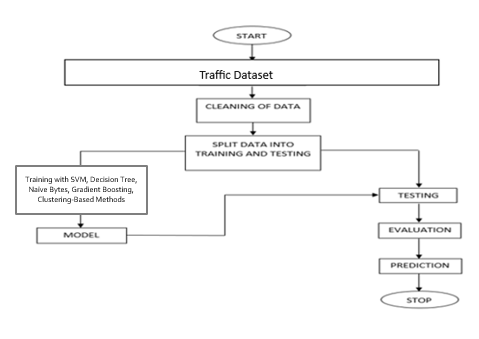
This study evaluates AI techniques (SVM, Decision Trees, Naive Bayes, Gradient Boosting) for classifying Onion Services in the Darknet amidst modified Tor traffic. It aims to identify key feature combinations, assess algorithm adaptability to traffic changes, and enhance Tor network security through improved traffic classification.
Abstract
This study investigates the influence of modified Tor traffic on the classification of Onion Services, unraveling the challenges associated with evolving Darknet activities. Employing a diverse set of machine learning algorithms, including Decision Trees, Naive Bayes, Gradient Boosting, and Clustering-based methods, we explore their effectiveness in discerning subtle modifications in Tor protocols. Through comprehensive experiments and evaluation metrics, our findings shed light on the robustness and adaptability of these algorithms in the face of sophisticated traffic manipulation. The results not only contribute to a deeper understanding of Darknet dynamics but also provide valuable insights for developing more resilient and responsive cybersecurity measures. This research advances the discourse on the intersection of machine learning and cybersecurity, emphasizing the need for innovative approaches to counter the evolving threats posed by modified Tor traffic in the realm of Onion Services.
Keywords: Darknet Traffic Analysis, Tor Network, Onion Services, Traffic Classification.
NOTE: Without the concern of our team, please don't submit to the college. This Abstract varies based on student requirements.
Block Diagram
Specifications
Hardware Requirements
Processor - I3/Intel Processor
Hard Disk - 160GB
Key Board - Standard Windows Keyboard
Mouse - Two or Three Button Mouse
Monitor - SVGA
RAM - 8GB
Software Requirements:
Operating System : Windows 7/8/10/11
Server side Script : HTML, CSS, Bootstrap & JS
Programming Language : Python
Libraries : Flask, Pandas, Mysql.connector, Os, Smtplib, Numpy
IDE/Workbench : PyCharm or VS Code
Technology : Python 3.6+
Server Deployment : Xampp Server
Database : MySQL


Related Projects
 Paper Publishing

Request Call Back
Would you like to receive a free callback now?
Choose the best time for callback:
Leave your message and we will contact you as soon as possible

6-2-85/B, Old Maternity Hospital Road, Thyagaraja Nagar, Tirupati, Andhra Pradesh – 517501
+91 9030333433
+91 9393939065
0877-2261612

Disclaimer - Takeoff Edu Group Projects are not associated or affiliated with IEEE in any way. The IEEE Projects mentioned here are mentioned in the context of student projects, whose ideas are derived from IEEE publications, not projects of or by IEEE.

