Conversational Predictive Maintenance Assistant for EV Fleet
Objective
The goal is to prepare EV battery data for machine learning models by normalizing and converting time series data. Classical algorithms like Decision Trees and Random Forest are applied to classify battery health and predict remaining useful life. Deep learning models such as XGBoost and Stacking Classifiers enhance predictions. A conversational assistant using NLP will provide fleet managers actionable insights. System performance is tested with accuracy, precision, recall, and F1-score, and the solution is validated using publicly accessible databases.
Abstract
The amount of performance and usage data that EV (electric vehicle) fleets generate is enormous during different cycles and charge-discharge activities. Remaining Useful Life (RUL) prediction of EV battery systems is essential in terms of optimization of maintenance strategies and optimization of operating cost. Nonetheless, the inconsistency of parameters such as voltage, charging, and discharge patterns among sources of battery power is a problem in the case of conventional rule-based systems. Therefore, we suggest a Conversational Predictive Maintenance Assistant that is based on the combination of a chatbot interface and machine learning algorithms to allow an inference window opened when it comes to user interaction and insights that allow sophisticated action.
The fundamental unit is dedicated to RUL estimation on the basis of Cycle Index, Discharge Time and Decrement (3.6 3.4V) Max.
Voltage Discharge, Minimum Voltage Charge, 4.15V time, Constant Current Time and Charging Time. There are supervised learning models e.g. Decision Tree, Random Forest and XGBoost besides a Stacking Classifier to enhance generalization and predictive robustness.
We use a conversational interface that will enhance user experience with Google Gemini API. The chatbot enables fleet managers and technicians to use natural language to communicate with the system to get predictions, learn how to behave with a model, and to get future suggestions on maintenance. This conversational interface does not only enhance accessibility, but it also democratizes predictive models usage in fleet practices.
It is a system based on a documented and labeled dataset in order to achieve optimal model performance and stability. Conversational interface bluntly the affinity gap between technical and usable operational experience, which contrasts with conventional dashboards, making it very well fit with the EV fleet operators, logistics companies and mobility-as-a-service platforms.
Keywords: Predictive Maintenance, EV Fleet, Remaining Useful Life (RUL), XGBoost, Random Forest, Decision Tree, Stacking Classifier, Gemini API, Conversational AI, Battery Health Monitoring, Smart Fleet Management, Machine Learning, Maintenance Forecasting, Chatbot, Time-Series Data.
NOTE: Without the concern of our team, please don't submit to the college. This Abstract varies based on student requirements.
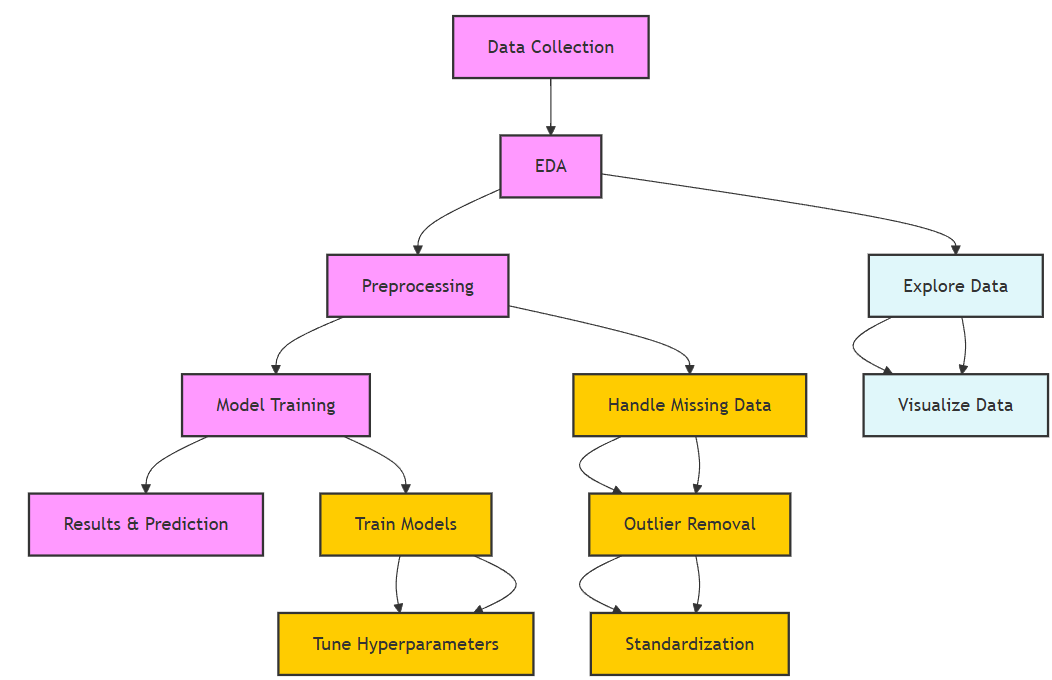
Block Diagram
Specifications
Hardware
(Processor: I5/Intel Processor, RAM: 8GB (min), Hard Disk: 128 GB, Key Board: Standard Windows Keyboard, Mouse: Two or Three Button Mouse)
Software
:
(Operating System: Windows 10, Programming Language: Python 3.10.8, IDE: VS Code)
Packages/Libraries:
(Sklearn, Transformers, Tensorflow, Pandas, Seaborn)


Related Projects
 Paper Publishing

Request Call Back
Would you like to receive a free callback now?
Choose the best time for callback:
Leave your message and we will contact you as soon as possible

6-2-85/B, Old Maternity Hospital Road, Thyagaraja Nagar, Tirupati, Andhra Pradesh – 517501
+91 9030333433
+91 9393939065
0877-2261612

Disclaimer - Takeoff Edu Group Projects are not associated or affiliated with IEEE in any way. The IEEE Projects mentioned here are mentioned in the context of student projects, whose ideas are derived from IEEE publications, not projects of or by IEEE.

